Life Questions & Guidance | Wisdom From The Vedas
Freedom from Guilt and Regret: Vedic Wisdom for Letting Go and Inner Peace
November 7, 2025 | By Madhura Samarth – Founder, MyEternalGuide

TL;DR: Vedic wisdom offers a path to freedom from guilt and regret by teaching that the true Self (Ātman) is inherently pure and is not defined by past actions. Through learnings from the Vedas, the Bhagavad Gita and stories such as the transformation of Valmiki, individuals can see how to transform remorse into growth. Awareness, right action (karma yoga), inner cleansing practices like prāyaścitta and surrender (śaraṇāgati) to the Divine are processes we can use to move forward. Rather than condemning human mistakes, the Vedic tradition shows us that guilt can become a doorway to wisdom, self-forgiveness and lasting inner peace, especially when combined with reflection, compassionate action and spiritual understanding.
The Weight We Carry Within
Every one of us has moments we wish we could rewrite — words we shouldn’t have said, choices that led to pain, paths we wish we hadn’t taken. These memories sit silently within, surfacing every now and then, whispering the same question — “Why did I do that?”
This unseen burden — of guilt, regret and self-judgment — is heavier than any physical weight. It keeps the mind restless and the heart anxious. In today’s times, where perfection is glorified and vulnerability is hidden, many of us silently carry this emotional load, not realizing that freedom begins not by forgetting, but by understanding.
The ancient seers of the Vedas understood this struggle deeply. They recognized that human beings, in their journey through lifetimes, would falter, err and suffer — but also, that the way out was already within. The Vedic path does not condemn the one who errs; it awakens the one who seeks to rise again.
At the heart of this awakening lies a sacred concept — Śaraṇāgati, the act of taking refuge at the feet of the Divine. It is not a gesture of weakness, but of immense strength. To surrender one’s guilt and regret into the compassionate hands of the Lord is the beginning of true healing. When one bows in surrender, the heart says:
“I no longer carry this alone. I place my mistakes at Your feet and I walk forward lighter.”
Letting go of the past, then, becomes an act of grace — a partnership between self-effort and divine acceptance. The Vedas remind us: “Whatever has been done, can be undone by knowledge, devotion and surrender.”
We will go on tol explore how Vedic wisdom transforms guilt into growth, regret into wisdom and how Śaraṇāgati — surrender to the Divine — can open the door to enduring inner peace.
Understanding Guilt and Regret Through the Vedic Lens
When we make a mistake, the natural response is to feel guilt — a signal from our conscience that something within us seeks harmony again. But over time, this healthy awareness can harden into regret, a repetitive self-punishment that disconnects us from the present. The Vedas and the Bhagavad Gita draw a clear distinction between awareness that uplifts and guilt that binds.
In the Vedic worldview, no human is inherently sinful. The soul (Ātman) is eternally pure, untouched by the limitations of mind and body. What binds us is karma — the result of our actions — not because the universe wishes to punish, but because it wishes to teach. When we forget this truth, we fall into self-condemnation and identify ourselves only with our errors, thinking, “I am the mistake.” The Vedas remind us — You are not the mistake; you are the one who can learn from it.
The Sanskrit word paapa (often translated as “sin”) has been widely misunderstood. It does not mean a permanent stain upon the soul. It simply refers to an action that disturbs the natural order (ṛta) and thus creates disharmony within us and around us. Such actions create an impression (saṁskāra) on the mind, which replays in the form of guilt and regret. The purpose of the Vedic path is to cleanse these impressions — not through denial or suppression, but through awareness, atonement and surrender.
The Bhagavad Gita (3.4) offers a profound insight:
“Na karmaṇām anārambhān naiṣkarmyaṁ puruṣo’śnute.”
One does not attain freedom from action by merely avoiding action.
Guilt often pushes us to inaction — to retreat, withdraw or punish ourselves. But the Gita reminds us that freedom lies in right action, not no action. The only way to purify past karma is by engaging with life again, this time with wisdom, compassion and detachment.
This detachment, however, is not cold indifference. It is born of understanding the temporary nature of both action and its result. The Vedic seers likened karma to ripples in a lake — each action creates movement, but stillness returns when one learns not to disturb the waters again.
One of the most compassionate teachings of the Vedic tradition is the concept of Śaraṇāgati — surrender at the Lord’s feet. Guilt arises when the ego holds on to the belief that “I alone am responsible for fixing my mistakes.” But when one takes refuge in the Divine, the burden lightens. To surrender is not to evade responsibility; it is to acknowledge a higher intelligence guiding the process of healing.
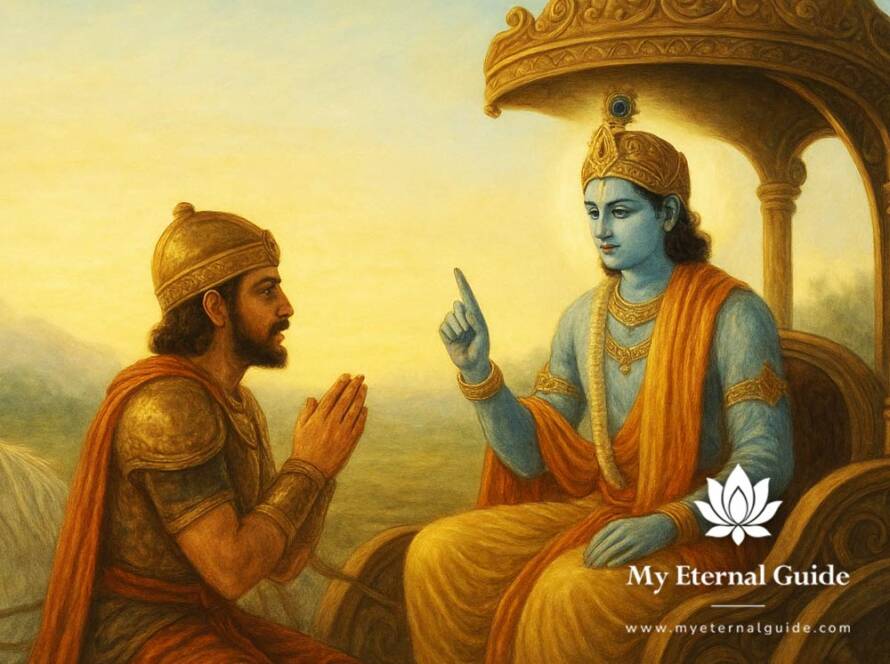
Surrender transforms guilt into humility. It changes the inner dialogue from “I have fallen” to “I am being lifted.” When Arjuna, paralyzed by guilt and despair on the battlefield, placed his bow down and said, “I am Your disciple. Teach me.” (Bhagavad Gita 2.7), that was Śaraṇāgati — the moment when despair became the doorway to wisdom.
In this light, guilt and regret are not enemies but messengers. They indicate that our inner compass still works — that our heart is sensitive, our spirit alive. The problem arises only when we let these emotions define us. The Vedas teach a middle path — acknowledge, learn, act and let go.
To let go of the past is not to erase it, but to integrate its lessons into our consciousness. Just as a tree absorbs the nutrients of fallen leaves to nourish new growth, the soul uses past experiences to mature. Every moment of awareness dissolves a layer of ignorance and every act of surrender restores our connection with the Self that has never been tainted.
Vedic wisdom thus invites us to see mistakes not as moral failures, but as opportunities for awakening. In recognizing our errors and surrendering them at the Lord’s feet, we participate in a divine cycle — falling, learning, rising — until the distinction between sinner and saint dissolves and only pure being remains.
The Root Cause of Guilt According to the Vedas
To understand guilt through the Vedic lens, we must look beyond emotion and into the mechanics of the mind. The Vedas teach that all human suffering arises from avidyā — ignorance of our true Self. Guilt, too, is a form of this ignorance. It comes from identifying completely with the doer — the limited “I” that acts, errs and bears the consequences. When we forget that the Ātman (the Self) is ever-pure, untouched by both virtue and vice, we begin to see ourselves not as divine beings having human experiences, but as flawed humans seeking divine forgiveness.
The Vedic seers describe this misidentification as the beginning of bondage. The Katha Upanishad tells us that the Self is like fire — ever bright and stainless — while the mind and body are like the smoke that surrounds it. When one confuses the smoke for the fire, the true nature of light is lost. Guilt arises when we see ourselves only through the smoke of past actions and forget the unburnt flame within.
In the Bhagavad Gita (5.14), Krishna declares:
“The Lord creates neither agency nor actions for the world; it is nature that acts.”
The deeper implication is profound — the divine Self within you is not the doer of actions. Actions arise through the interplay of the three guṇas (qualities of nature: sattva, rajas and tamas). The soul merely witnesses. Yet, when the ego claims ownership — “I did this” — it also claims guilt. The root cause of guilt is therefore ahaṅkāra — the ego’s belief that it controls everything.
This does not mean we escape responsibility. Rather, it shifts the way we perceive it. True responsibility is to act consciously, learn from our actions and then release attachment to outcomes. Guilt, on the other hand, is the refusal to release — a mental loop that keeps replaying the same moment of ignorance. It is the mind’s way of saying, “If I keep revisiting it, I can undo it.” But the Vedas remind us: the past cannot be undone by thinking — only by transforming.
The story of Sage Vālmīki beautifully captures this Vedic understanding of transformation through surrender. Before he became a revered sage, Vālmīki was known as Ratnākara, a hunter and robber who lived by looting travelers in the forest. One day, he encountered the celestial sage Nārada, whose serene presence stopped him in his tracks.
Curious yet defiant, Ratnākara confessed that he robbed to support his family. Nārada then asked a question that pierced his heart: “Will your family share the burden of your sins as they share your earnings?” Confidently, Ratnākara returned home to ask them — but each member, one by one, refused. His wife, his parents, his children — all said they could share his food and wealth, but not his wrongdoing.
That moment of realization broke him. Overwhelmed by guilt and sorrow, he fell at Nārada’s feet and pleaded for redemption. The compassionate sage instructed him to meditate on the name of Lord Rāma, saying that this alone could purify his heart. But Ratnākara, living so long in ignorance, found it difficult even to pronounce the holy name.
So, Nārada guided him gently: “Then say Mara — meaning ‘death.’” Ratnākara began repeating “Mara, Mara, Mara,” and as the sound flowed, it naturally reversed to “Rāma, Rāma, Rāma.” Immersed in that vibration, he entered a deep meditative state. Legend says that he sat in stillness for years, covered in an anthill — valmīka in Sanskrit — and when he finally emerged, he was reborn as Sage Vālmīki, the enlightened author of the Rāmāyaṇa.
This transformation is not merely a story of devotion; it is a profound Vedic truth in motion. Ratnākara’s guilt did not destroy him — it became the very force that turned him toward grace. When he took refuge (Śaraṇāgati) at the feet of the Divine, his remorse was transmuted into bhakti — devotion. The ego that once said, “I do,” surrendered to the awareness, “Thou art the doer.”
Vālmīki’s journey reveals the true purpose of guilt: not to imprison, but to awaken. In the Vedic view, every error carries within it the seed of enlightenment — if we allow it to humble, rather than harden, the heart. The act of surrender transforms guilt into growth, regret into remembrance of the Divine.
The same principle applies to each of us today. When we hold on to guilt, we remain stuck in the identity of the doer — the small self. But when we offer that guilt at the Lord’s feet, saying, “I surrender what I cannot undo to the One who can transform all,” we participate in the eternal rhythm of renewal. This is the living essence of Śaraṇāgati — taking shelter at the Lord’s feet not as a last resort, but as a conscious act of trust in divine grace.
Freedom from guilt, then, is not an act of forgetting, but of remembering — remembering who we truly are. When we see ourselves as the eternal Self, we realize that no mistake has the power to define us. The fire of awareness burns all impurities and what remains is pure consciousness — the true “you” that has never been guilty, only growing.
The Practice of Prāyaścitta — Vedic Method of Inner Cleansing
Once a person recognizes the roots of guilt and regret, the next step is not to suppress them, but to purify them. In the Vedic path, this purification is known as Prāyaścitta — a Sanskrit term often misunderstood as “penance,” but whose essence is far more compassionate and intelligent. Prāyaścitta literally means “to make right again” — an act of inner cleansing that restores balance between the mind, soul and the cosmic order (ṛta).
The Vedas teach that every action creates a subtle vibration in the universe. When we act in ignorance, those vibrations create dissonance — a disturbance that we experience as guilt or unrest. Prāyaścitta is the process of retuning ourselves to harmony. It does not punish; it purifies. It is not about carrying the burden of our past, but about releasing it into the light of awareness and right action.
The Inner Science of Prāyaścitta
The Manu Smriti (11.228) says,
“Knowledge and repentance are the best of all purifiers for the wise.”
This verse reveals the two pillars of Vedic atonement — Jñāna (knowledge) and Kriyā (action). It is not enough to merely regret; one must understand why a mistake happened and take conscious steps to realign.
In ancient times, Prāyaścitta took the form of mantra recitation, fasting, charity and selfless service (seva). These were not rituals of guilt, but instruments for mental purification. Each practice targeted a specific layer of the self — the body, the senses, the emotions and the intellect — gradually restoring harmony.
In our modern world, these can be beautifully reinterpreted:
- Mantra recitation becomes meditative repetition — consciously replacing negative thoughts with divine sound.
- Charity or seva becomes an act of balancing karma through compassion — transforming energy outward into love.
- Fasting or simplicity becomes a symbolic act of detachment — a reminder that our worth is not tied to indulgence or error.
- Self-study (Svādhyāya) means reflective introspection — reading sacred wisdom and observing one’s own mind honestly, without judgment.
A Mantra for Renewal
Among the most profound Vedic verses for inner cleansing is the Bṛhadāraṇyaka Upanishad prayer:
“Om Asato Mā Sadgamaya,
Tamaso Mā Jyotirgamaya,
Mrityor Mā Amritam Gamaya.”
(Lead me from untruth to truth, from darkness to light, from mortality to immortality.)
Listening to or chanting this mantra invokes the vibration of renewal. It reminds the heart that we are never stuck — that at any moment, through sincere repentance and surrender, transformation begins. You can listen to a pure and authentic Sanskrit rendition by the Chinmaya Mission here: Vedic Chant by Chinmaya Mission.
When recited with attention, the mantra begins to cleanse subtle impressions of guilt from the subconscious. The Vedas explain that sound (śabda) is not merely auditory — it carries shakti, transformative energy. This is why japa (repetition of the Divine Name) was prescribed even for those who had committed grave errors. Through sustained repetition, the mind gradually aligns with purity and peace.
Śaraṇāgati — The Ultimate Prāyaścitta
While rituals and actions help, the highest form of Prāyaścitta is Śaraṇāgati — complete surrender to the Divine. When the mind accepts that the doer is limited but the Divine is infinite, a deep relaxation dawns within. You stop trying to atone through endless worry and instead, you offer the burden itself at the Lord’s feet. This act of surrender instantly transforms remorse into devotion.
Lord Krishna assures in the Bhagavad Gita (18.66):
“Sarva-dharmān parityajya mām ekaṁ śaraṇaṁ vraja.
Ahaṁ tvā sarva-pāpebhyo mokṣayiṣyāmi mā śucaḥ.”
(Abandon all forms of duty and take refuge in Me alone. I shall liberate you from all sin; do not grieve.)
These words are not a promise of exemption from consequences, but a guarantee of inner freedom. When surrender is sincere, guilt no longer corrodes the heart. The Divine transforms past karma into wisdom and strength.
Modern Applications of Prāyaścitta
In daily life, you can practice Prāyaścitta in simple yet powerful ways:
- Morning Reflection: Begin the day with three deep breaths and silently say, “May my actions today bring harmony to all.”
- Acts of Compassion: Offer help or kindness to someone in need — not to erase guilt, but to balance inner energy through giving.
- Evening Surrender: Before sleep, mentally offer your entire day — its errors and achievements — at the Lord’s feet.
- Weekly Silence: Dedicate one hour each week to quiet reflection, where you let the mind settle, observe regrets that arise and gently release them through prayer or journaling.
When done with sincerity, these practices gradually dissolve the residue of guilt and restore śānti — inner peace.
The Essence
Prāyaścitta is not about self-punishment; it is self-realignment. It transforms guilt into gratitude — gratitude for the awareness that helps you grow. When combined with Śaraṇāgati, it becomes a sacred offering, where even mistakes are transformed into stepping stones toward awakening.
The Vedas remind us: “No action is ever wasted when done in the light of truth.” To practice Prāyaścitta is to remember that within every heart that feels remorse lies the seed of liberation itself.
Transforming Regret into Wisdom — The Gita’s Formula
Regret is one of the most persistent emotions we face. It arrives quietly, long after the moment has passed — whispering, “If only I had done things differently.” While guilt focuses on our perceived wrongdoing, regret fixates on our lost opportunity. Both are heavy because they anchor us to the past. The Vedas and particularly the Bhagavad Gita, offer a profound method to transform regret into wisdom through the art of karma yoga — the yoga of selfless action.
When Arjuna stood on the battlefield of Kurukshetra, his heart was paralyzed by guilt and regret. He trembled at the thought of raising arms against his own kin. His bow fell and his mind spiraled into self-condemnation — “I have become the cause of destruction.” This moment of moral conflict mirrors the inner war each of us faces when our actions or choices haunt us.
Krishna, standing beside him as his charioteer and guide, does not dismiss Arjuna’s feelings. Instead, He reveals the truth of dharma — that our purpose is not to cling to results but to act in alignment with righteousness. His teaching, timeless and practical, pierces the heart of regret:
“Karmanye vādhikāras te, mā phaleṣu kadācana.”
(You have the right to action alone, but never to its fruits.) — Bhagavad Gita 2.47
This one verse is the Gita’s antidote to regret. We suffer not because of what we did, but because we are attached to what we wanted the outcome to be. When things go wrong, the mind replays the past endlessly — trying to mentally rewrite what cannot be changed. But Krishna reminds Arjuna and through him all humanity, that peace is not found by controlling the past, but by acting rightly now, in full awareness and surrender.
The Gita’s formula for transformation is threefold:
- Right Understanding (Jñāna) — Seeing Clearly
Regret loses power when we see life as a continuous process of learning, not a series of isolated failures. Krishna’s wisdom invites us to see that every situation — even painful ones — is part of the divine design for our growth. Instead of “Why did this happen to me?”, the seeker asks, “What truth is this revealing to me?” - Right Action (Karma) — Moving Forward
The Gita teaches that transformation happens through action, not paralysis. When we wallow in regret, we freeze the flow of energy. But when we act again — with humility and awareness — we realign ourselves with dharma. Each conscious action becomes a sacred offering (yajña), cleansing the residue of the past. - Right Surrender (Śaraṇāgati) — Letting the Divine Lead
The final step is surrender. Not the surrender of effort, but the surrender of ownership. Arjuna’s moment of liberation begins when he says, “Kārpaṇya-doṣopahata-svabhāvaḥ… śiṣyas te ’haṁ śādhi māṁ tvāṁ prapannam.”
(My nature is overcome by weakness; I am Your disciple. Please instruct me, for I take refuge in You.) — Bhagavad Gita 2.7
That one act of surrender turned despair into devotion. When the ego stops insisting on being the doer, regret transforms into grace.
Practical Application in Modern Life
In our world now, where every decision feels magnified and mistakes often replay endlessly in our minds, Krishna’s teaching is profoundly relevant. The Gita doesn’t ask us to erase the past — it teaches us to act so that the present becomes redemptive.
Here are a few practical ways to apply this formula:
- Shift the Question: Instead of asking “What if?” — ask “What now?” This simple reframe moves the mind from stagnation to motion.
- Perform One Healing Act Daily: A kind word, a helping hand or a moment of prayer directed toward someone you’ve hurt can neutralize layers of karmic regret.
- Journaling as Yajña: Each night, write one lesson your regret has taught you. Offer that reflection to the Divine, mentally saying, “This too, I place at Your feet.”
- Breathwork (Prāṇāyāma): Use conscious breathing — inhaling awareness, exhaling release. The breath, say the Upanishads, is the bridge between the inner and outer worlds.
Even in psychology today, there’s growing recognition that regret can become a catalyst for change when met with acceptance rather than self-condemnation. The Vedas reached this understanding thousands of years ago. The Gita integrates it beautifully — teaching us that it’s not about forgetting what we’ve done, but remembering who we truly are beneath it.
When you act in awareness and surrender the result, every action becomes a form of purification — a living Prāyaścitta. As Krishna assures:
“Even if the most sinful person worships Me with undivided devotion, he is to be considered righteous, for he has resolved rightly.” — Bhagavad Gita 9.30
In that verse lies the full transformation of regret into wisdom. The moment we turn to the Divine in sincerity, even the darkest past becomes sacred soil for new growth. This is Śaraṇāgati in its purest form — not escape from life, but complete participation in it with trust in divine justice.
To live without regret, therefore, is not to live without mistakes. It is to live with awareness, humility and surrender — knowing that each moment offers a chance to rise higher in understanding. The past is a teacher, not a prison. When we let go of it in the spirit of the Gita, we discover that what once felt like punishment was actually preparation — leading us back to the freedom of the Self that has never fallen and never truly failed.
The Subtle Art of Self-Forgiveness
Forgiving others is difficult; forgiving ourselves is often far harder. We can rationalize others’ mistakes, but our own missteps echo louder — replayed endlessly in the mind. Yet, according to Vedic wisdom, self-forgiveness is not indulgence; it is an act of spiritual intelligence. It is the recognition that the same Divine Self (Ātman) that dwells in all beings shines within us too — untouched by the imperfections of the human experience.
In the Vedic vision, self-forgiveness is not about erasing the past but about seeing it through the eyes of awareness. The Ātman is changeless, eternal and pure. Only the mind errs; only the ego clings. When we say, “I cannot forgive myself,” we are actually saying, “I cannot forgive my mind for being ignorant.” But how can ignorance be healed except through understanding?
The Chāndogya Upanishad gives us a poetic reminder:
“Tat tvam asi — Thou art That.”
You are not the sum of your errors or achievements; you are the consciousness that witnesses both. To truly forgive yourself is to stop misidentifying with the shadow and remember the sun that always shines behind it.
Ahalyā’s Redemption — Grace Beyond Guilt
One of the most moving illustrations of self-forgiveness in our tradition is the story of Ahalyā. Deceived by the illusion of Indra, she was cursed by her husband, Sage Gautama, to become stone — a metaphor for her own frozen heart, locked in guilt and shame. Yet the curse carried within it the seed of her liberation: it was decreed that she would be freed when Lord Rāma’s feet touched her.
When Rāma later walked through the forest, his presence — pure, compassionate and filled with divine grace — broke her curse. The touch of the Divine restored her to her true nature. In that moment, she did not return to her past; she transcended it.
Ahalyā’s story is not about punishment, but about Śaraṇāgati — the surrender that melts guilt into grace. She could not free herself by intellect or penance alone; she was redeemed by the remembrance of her divine source. Likewise, we too are liberated when we turn inward and allow the Divine Presence within us to touch the hardened parts of our heart.
Self-forgiveness, in this sense, is not something we do; it is something we allow. It happens naturally when we stop resisting the truth of who we are.
The Vedic Path to Self-Forgiveness
The Vedas prescribe three subtle steps to release self-condemnation and awaken compassion toward oneself:
- Accept — Without Judgment
Acceptance does not mean approval. It means acknowledging the fact of what happened without emotional distortion. Sit quietly and say to yourself, “This too was part of my learning.” This simple recognition loosens the knot of shame that binds the heart. - Reflect — With Awareness
In Vedic psychology, awareness itself is purifying. When the light of understanding touches guilt, it dissolves. Reflect on what the experience has taught you — not as punishment, but as instruction from life itself. This transforms memory into wisdom. - Surrender — With Love
Finally, offer your regret to the Divine. This is Śaraṇāgati in its most personal form. Mentally visualize placing your mistake at the Lord’s feet — Rāma, Krishna, Shiva, Devi or whichever form of the Divine speaks to your heart. Whisper inwardly:
“I have carried this long enough. I surrender it to You. Let me walk forward free.”
As this practice deepens, forgiveness ceases to be a mental act and becomes an inner fragrance — the natural scent of a heart at peace.
Modern Reflections
Today, in our world of self-help, forgiveness is often treated as a psychological tool. But the Vedic view is subtler: forgiveness is not just a decision of the mind; it is a return to the Self. Modern psychology often teaches that “you are enough.” The Vedas go further — they reveal, “You are complete.” The Sanskrit word pūrṇa means wholeness — and that is your true nature. The one who realizes this cannot remain bound by guilt.
When you understand this, self-forgiveness becomes a sacred act of remembering rather than repairing. You realize that nothing real was ever damaged — only your perception of yourself was clouded. The Gita expresses this beautifully:
“Even as fire reduces wood to ashes, the fire of knowledge burns all actions to ashes.” — Bhagavad Gita 4.37
Once you recognize the divine spark within, guilt has no soil left to root in. The mind may still recall mistakes, but the heart responds with compassion instead of condemnation.
To practice this in daily life:
- Begin each morning by acknowledging your divine nature: “I am That which cannot be stained by past actions.”
- When regret arises, place your right hand on your heart and repeat softly, “I forgive myself because I now understand.”
- End the day by mentally offering all your actions — good and bad — to the Divine, in gratitude for the lessons learned.
This daily surrender transforms ordinary living into sacred living. Guilt loses its hold and life begins to flow again with ease and clarity.
Forgiveness, then, is not forgetting the past — it is remembering the truth of the present. When the heart bows in Śaraṇāgati, the Divine forgives instantly, because the Self was never guilty. What remains is peace — vast, luminous and unconditional.
The Way Forward — Living Guilt-Free in a Vedic Way
To live guilt-free is not to live without conscience; it is to live with clarity. The Vedic path does not ask us to deny our past or to escape from responsibility — it teaches us how to carry wisdom instead of weight. When guilt becomes awareness and regret turns into understanding, life itself becomes an offering — a continuous yajña (sacred act).
The Meaning of a Guilt-Free Life
“Guilt-free” often means living recklessly, without accountability. The Vedic idea is very different. Freedom from guilt comes not from denial, but from alignment — aligning thoughts, words and actions with dharma, the universal order. The one who acts with viveka (discernment) and shraddhā (faith) is naturally at peace, because they no longer act out of compulsion or ego.
When we live with this awareness, even mistakes lose their sting. A dhārmic person is not one who never errs, but one who learns quickly and acts again in harmony. The Vedas see human life as a vast experiment in consciousness — not a courtroom. Every experience is meant to teach, refine and awaken us.
The Taittirīya Upanishad says:
“Satyam vada, dharmam chara.”
(Speak truth, live righteously.)
These simple words summarize the Vedic way of living guilt-free. Speak truth — not just to others, but to yourself. Live in harmony with the rhythm of righteousness. When you live like this, you do not accumulate guilt, because your inner and outer selves are aligned.
Ahimsa Toward the Self
The great Vedic principle of Ahimsa — non-violence — applies not only to others but also to oneself. Most of us practice outward non-violence but silently wage war within. Harsh self-criticism, constant replaying of mistakes and the inability to forgive ourselves — these are subtle forms of himsa (violence) against the self.
True Ahimsa begins when you stop hurting yourself in thought. Each time you mentally punish yourself for the past, remember — the Divine within you is compassion itself. Would He condemn what He created? The Upanishads remind us that the Self is “śāntam, śivam, advaitam” — peace, auspiciousness, oneness. When you connect with this truth, guilt has no ground to stand on.
Living the Vedic Way — Daily Practices
Here are practical ways to integrate this understanding and live free of guilt and regret:
- Begin with Gratitude: Start your day by acknowledging the grace that allowed you another chance. Say inwardly, “Whatever happened, I am learning. Thank you for this new dawn.”
- Practice Self-Awareness: Before speaking or acting, pause for one breath. Ask, “Is this action aligned with dharma?” This simple moment of awareness prevents actions that lead to future remorse.
- Offer Everything: Whatever you do — work, conversation, rest — dedicate it to the Divine as Iśvara-arpanam (offering to God). When everything becomes offering, nothing becomes burden.
- Evening Reflection: At night, mentally revisit your day without judgment. See what was learned, not what was lost. End with a small prayer of surrender:
“O Lord, may all I did today, knowingly or unknowingly, serve Your purpose. Forgive and guide me.” - Silence Once a Week: Spend an hour in silence (mauna). Let the mind settle. Often, guilt is just the noise of the ego trying to control what has already passed. In silence, the ego softens and peace emerges naturally.
The Grace of Time and the Flow of Karma
The Vedas describe time (kāla) as the great healer. Just as a river purifies itself by flowing, so does life cleanse through movement. The pain of guilt comes when we resist this flow — when we cling to what was instead of what is. But karma, when accepted and understood, becomes education rather than punishment.
Each experience is part of a divine curriculum. To live the Vedic way is to recognize that even your mistakes were divinely permitted for your evolution. The moment you see this, guilt loses its meaning.
Krishna says in the Bhagavad Gita (6.5):
“Uddhared ātmanātmānaṁ nātmānam avasādayet.”
(Lift yourself by yourself; do not degrade yourself.)
This is self-compassion in its purest form. The Divine is not asking you to be perfect, only to rise — again and again, with awareness.
A Simple Daily Affirmation
Before sleep, place your hand on your heart and repeat softly:
“Today, I choose peace. I have learned from the past and I release it into Your hands.”
This practice aligns with Śaraṇāgati — surrender at the Lord’s feet. It is not resignation; it is trust. When you surrender daily, life itself becomes prayer.
Living guilt-free does not mean becoming indifferent to right and wrong; it means living with continuous renewal. The Vedas call this state śānti — peace that arises not from perfection, but from presence.
Remember — the soul is eternally pure, untouched by the past. Guilt belongs to the mind; peace belongs to the Self. The more you identify with the Self, the lighter life becomes.
The Path to Inner Peace
At some point in every seeker’s journey, there comes a quiet realization: the past no longer needs to be carried. It has already served its purpose. The pain, the mistakes, the guilt — each was a teacher in disguise, guiding us closer to truth. The Vedic path does not ask us to erase the past; it invites us to redeem it by transforming memory into wisdom and guilt into gratitude.
The Vedas remind us that peace (śānti) is not something to be attained — it is what remains when the turbulence of the mind subsides. The act of letting go is not passive; it is a deeply conscious choice. When we choose understanding over judgment, awareness over avoidance, surrender over control, we reclaim our original state — that of harmony with the universe.
All along, the Divine has been waiting — not to punish, but to receive. When we take Śaraṇāgati, refuge at the Lord’s feet, we align ourselves with the flow of grace that has always been there. Just as the river finds rest only in the ocean, the restless heart finds peace only in surrender.
Krishna’s timeless assurance in the Bhagavad Gita (18.66) echoes across millennia:
“Sarva-dharmān parityajya mām ekaṁ śaraṇaṁ vraja, ahaṁ tvā sarva-pāpebhyo mokṣayiṣyāmi mā śucaḥ.”
(Abandon all other forms of duty and take refuge in Me alone. I shall free you from all sin; do not grieve.)
These words are not just theology — they are therapy. To live by them is to walk free.
Every story we explored — from Vālmīki’s redemption to Ahalyā’s awakening — reveals a single truth: what the Divine touches, it transforms. The same Divine spark that lifted them shines within you. When you surrender your guilt, regret and fear to that presence, you rediscover your inherent purity.
In the end, letting go is not forgetting what was — it is remembering who you are. You are not your past actions, not your mistakes, not even your thoughts. You are Sat-Chit-Ānanda — existence, consciousness, bliss — ever whole, ever free.
When you forgive yourself and release the burden of guilt, you honor the purpose of human life: to evolve, to awaken and to return to your natural state of joy. That is the Vedic promise — no darkness is permanent when faced with the light of awareness.
Let this moment be your turning point. Close your eyes, take a deep breath and inwardly say, “I am forgiven, for I am one with the Divine.”
If this message resonates with your heart, take the next step toward your own renewal. Visit www.myeternalguide.com — a space where timeless Vedic wisdom meets everyday life. You can ask your question for free, anytime and receive guidance drawn from the ancient scriptures — helping you walk lighter, live clearer and rediscover peace within.
Frequently Asked Questions (FAQs)
2. According to the Vedas, am I my mistakes?
No. The Vedas clearly distinguish between you and your actions. You are not the mistake; you are the one who can learn from it. Actions create karma and mental impressions, but your true Self remains untouched, like a clear sky behind passing clouds.
3. What is Śaraṇāgati and how does it help with guilt?
Śaraṇāgati means taking refuge at the feet of the Divine. It is a conscious surrender of your guilt, regret and burden into the hands of a higher intelligence. Instead of “I must fix everything alone,” the inner attitude becomes “I offer this to You and walk forward lighter,” which is the beginning of deep emotional healing.
4. How can I let go of past mistakes using Vedic wisdom?
Vedic wisdom suggests a four-step approach: acknowledge the mistake honestly, understand why it happened, take right corrective action and then surrender the burden to the Divine. When you combine self-awareness, responsible action and Śaraṇāgati, the past stops feeling like a prison and becomes a teacher.
5. What is Prāyaścitta in the Vedic tradition?
Prāyaścitta is the Vedic method of inner cleansing, often translated as “atonement” or “making things right.” It includes practices like sincere repentance, mantra recitation, charity, selfless service and self-study (Svādhyāya) — all aimed at purifying guilt and restoring harmony between you, your mind and the larger cosmic order.
6. How does the Bhagavad Gita help transform regret into wisdom?
The Bhagavad Gita teaches karma yoga — focusing on right action rather than clinging to results. Verses like “Karmanye vādhikāras te, mā phaleṣu kadācana” show that peace comes from acting in alignment with dharma now, not from endlessly replaying the past. When you act with awareness and surrender outcomes, regret gradually turns into wisdom.
7. What is the root cause of guilt according to the Vedas?
The root cause of guilt is avidyā — ignorance of your true nature — and ahaṅkāra, the ego’s belief that “I am the sole doer.” When you identify only with the small self that acts and errs, you feel crushed by guilt. When you remember the higher Self as witness and surrender the ego, guilt softens into humility and growth.
8. How do stories like Vālmīki and Ahalyā relate to guilt and redemption?
Both Vālmīki and Ahalyā are powerful Vedic examples of transformation. Vālmīki moves from robber to sage through repentance, mantra and surrender; Ahalyā moves from stone-like guilt to freedom through the touch of divine grace. These stories show that no past is too dark to be transformed when there is sincere remorse and Śaraṇāgati.
9. What is the Vedic way to practice self-forgiveness?
The Vedic path to self-forgiveness involves three steps: accepting what happened without denial, reflecting on the lessons with honest awareness and finally surrendering the regret at the Lord’s feet. You forgive not by erasing the past, but by seeing yourself as the Ātman — whole, complete and capable of starting again.
10. How can I live guilt-free without becoming careless or irresponsible?
Living guilt-free in a Vedic way does not mean living without conscience. It means aligning thought, word and action with dharma, practicing Ahimsa (non-violence) even in your self-talk and correcting mistakes quickly and humbly. When you act with discernment and devotion, you prevent new guilt from forming while learning from the old.
11. Are there simple daily Vedic practices to release guilt and regret?
Yes. You can begin and end your day with a short prayer of surrender, practice mantra japa, perform small acts of kindness as a form of Prāyaścitta and spend a few minutes in honest reflection without self-attack. These simple habits gradually cleanse inner heaviness and bring lasting śānti (peace).
12. How does Śaraṇāgati differ from escapism or avoiding responsibility?
Escapism avoids responsibility; Śaraṇāgati honours it. You still acknowledge your actions, make amends where needed and take corrective steps — but you stop carrying the emotional burden alone. You do your best and consciously hand over the rest to the Divine, trusting that grace will transform what you cannot.
13. Can I get personalized Vedic guidance to deal with my guilt and regret?
Yes. If you’re struggling with a specific situation, you can ask your question on platforms like MyEternalGuide.com, where answers are rooted in Vedic scriptures such as the Upanishads, Bhagavad Gita and Ramayana. This helps you apply ancient wisdom directly to the emotional challenges you face today.
In the Vedic tradition, you are not seen as inherently sinful. The soul (Ātman) is eternally pure; guilt and regret arise from actions (karma) and the impressions they leave on the mind. Instead of condemning you, Vedic wisdom invites you to learn from mistakes, purify the mind and grow spiritually.
No. The Vedas clearly distinguish between you and your actions. You are not the mistake; you are the one who can learn from it. Actions create karma and mental impressions, but your true Self remains untouched, like a clear sky behind passing clouds.
Śaraṇāgati means taking refuge at the feet of the Divine. It is a conscious surrender of your guilt, regret and burden into the hands of a higher intelligence. Instead of “I must fix everything alone,” the inner attitude becomes “I offer this to You and walk forward lighter,” which is the beginning of deep emotional healing.
Vedic wisdom suggests a four-step approach: acknowledge the mistake honestly, understand why it happened, take right corrective action and then surrender the burden to the Divine. When you combine self-awareness, responsible action and Śaraṇāgati, the past stops feeling like a prison and becomes a teacher.
Prāyaścitta is the Vedic method of inner cleansing, often translated as “atonement” or “making things right.” It includes practices like sincere repentance, mantra recitation, charity, selfless service and self-study (Svādhyāya) — all aimed at purifying guilt and restoring harmony between you, your mind and the larger cosmic order.
The Bhagavad Gita teaches karma yoga — focusing on right action rather than clinging to results. Verses like “Karmanye vādhikāras te, mā phaleṣu kadācana” show that peace comes from acting in alignment with dharma now, not from endlessly replaying the past. When you act with awareness and surrender outcomes, regret gradually turns into wisdom.
The root cause of guilt is avidyā — ignorance of your true nature — and ahaṅkāra, the ego’s belief that “I am the sole doer.” When you identify only with the small self that acts and errs, you feel crushed by guilt. When you remember the higher Self as witness and surrender the ego, guilt softens into humility and growth.
Both Vālmīki and Ahalyā are powerful Vedic examples of transformation. Vālmīki moves from robber to sage through repentance, mantra and surrender; Ahalyā moves from stone-like guilt to freedom through the touch of divine grace. These stories show that no past is too dark to be transformed when there is sincere remorse and Śaraṇāgati.
The Vedic path to self-forgiveness involves three steps: accepting what happened without denial, reflecting on the lessons with honest awareness and finally surrendering the regret at the Lord’s feet. You forgive not by erasing the past, but by seeing yourself as the Ātman — whole, complete and capable of starting again.
Living guilt-free in a Vedic way does not mean living without conscience. It means aligning thought, word and action with dharma, practicing Ahimsa (non-violence) even in your self-talk and correcting mistakes quickly and humbly. When you act with discernment and devotion, you prevent new guilt from forming while learning from the old.
Yes. You can begin and end your day with a short prayer of surrender, practice mantra japa, perform small acts of kindness as a form of Prāyaścitta and spend a few minutes in honest reflection without self-attack. These simple habits gradually cleanse inner heaviness and bring lasting śānti (peace).
Escapism avoids responsibility; Śaraṇāgati honours it. You still acknowledge your actions, make amends where needed and take corrective steps — but you stop carrying the emotional burden alone. You do your best and consciously hand over the rest to the Divine, trusting that grace will transform what you cannot.
Yes. If you’re struggling with a specific situation, you can ask your question on platforms like MyEternalGuide.com, where answers are rooted in Vedic scriptures such as the Upanishads, Bhagavad Gita and Ramayana. This helps you apply ancient wisdom directly to the emotional challenges you face today.