Krishna & The Mind: The Gita’s Insights On Human Psychology
November 19, 2025 | by Madhura Samarth – Founder, MyEternalGuide
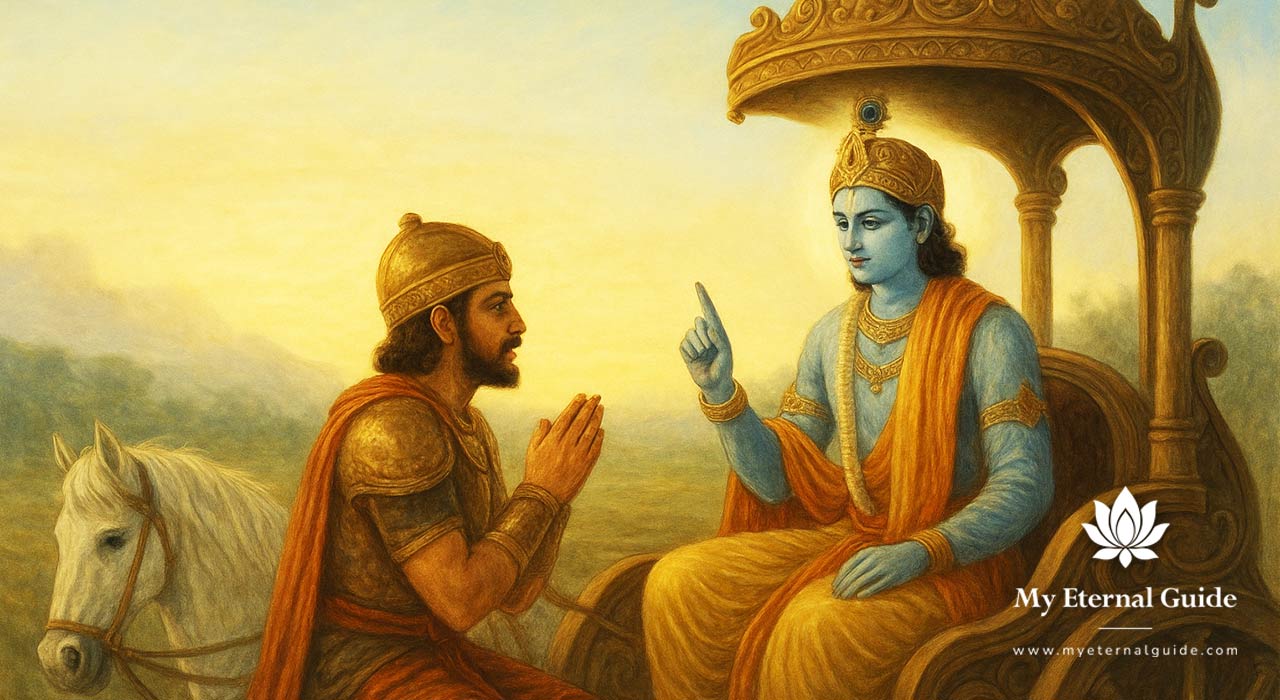
TL;DR: The Bhagavad Gita presents one of the world’s earliest psychological frameworks for understanding stress, anxiety and decision-making through the dialogue between Krishna and Arjuna on the battlefield of Kurukshetra. By explaining concepts like manas (emotional mind), buddhi (intellect), ahamkara (ego) and the three gunas (sattva, rajas and tamas), the Gita offers a timeless model of human psychology that closely parallels modern approaches such as cognitive-behavioral therapy, mindfulness and values-based living. These teachings show how observing thoughts, acting according to one’s values (dharma) and reducing attachment to outcomes can improve emotional resilience, clarity and mental well-being in modern life.
At some point in time, we’ve all felt that our mind is under siege, almost constantly. Notifications buzz every few minutes. Workloads rise faster than we can manage. Relationships demand more emotional intelligence than ever. And beneath all of this, there is a quiet voice inside many of us asking: “Why am I feeling so overwhelmed, even when I’m doing everything right?”
Whether you call it anxiety, overthinking, burnout or emotional fatigue—every generation believes its problems are unique. But the Vedic view gently reminds us: there are no new problems. Human emotions have remained the same for thousands of years. What we face today has been faced before. And solutions exist—timeless, precise and astonishingly relevant.
One of the greatest sources of this eternal wisdom is the Bhagavad Gita, a sacred dialogue spoken more than 5,000 years ago. But here’s the part modern readers often miss: the Gita is not only a spiritual text—it is also one of the earliest and most practical manuals on psychology.
In fact, when we read it with a modern lens, Krishna emerges not just as a divine guide but as a profound psychologist who understood the human mind in a way that contemporary science is only beginning to validate. His teachings to Arjuna on the battlefield are not abstract philosophy. They are deeply psychological instructions on how to think clearly, act wisely and manage emotions even in the most intense, confusing or painful moments of life.
And this isn’t just a devotional interpretation. Modern psychological research is now catching up.
- Research published through the National Institutes of Health shows that the Bhagavad Gita’s teachings on equanimity, duty and detachment align strongly with evidence-based clinical approaches for reducing anxiety and stress.
- An APA-indexed study highlights how principles rooted in the Gita—such as moderation, mindful action and self-regulation—mirror the foundations of modern cognitive-behavioral therapy.
- A 2021 paper in the Journal of Religion and Health found that spiritual frameworks grounded in the Bhagavad Gita significantly enhance psychological resilience, emotional balance and overall well-being.
How could a text composed millennia ago align so closely with what today’s therapists, neuroscientists and psychologists advocate? The answer is simple: because human nature has not changed. Krishna’s insights into the mind, emotions, duty, fear, ego and inner conflict are descriptions of the universal human condition.
And that is why the Gita feels so shockingly modern.
In this blog, we will explore how Krishna’s teachings form a complete psychological map—one that explains why we feel mental distress, how we distort reality and what we must do to regain clarity and peace. Whether you are a spiritual seeker, a curious reader from another faith or a Hindu reconnecting with your heritage, the insights ahead will show you what the Gita truly is: a timeless guide for the human mind.
At MyEternalGuide, we believe that wisdom becomes powerful only when it becomes practical. So as you read, reflect on your life, your challenges, your decisions. You’ll see how the Gita still speaks directly to you—5,000 years later. If at any point a question arises in your heart, you can always ask it for free on www.myeternalguide.com.
What Was Arjuna Really Experiencing? The First Recorded Case Study in Psychology
At this point in the Mahabharata, Arjuna stands on the battlefield of Kurukshetra—facing a war he never wanted. On one side are his brothers and allies; on the other, his cousins, teachers, elders and friends. The conflict has become unavoidable after years of injustice, political manipulation and failed attempts at peace. As Arjuna surveys the field, he realises that victory will demand the destruction of people he deeply respects and loves. This is not simply a soldier preparing for battle; it is a man caught between duty and grief, justice and affection, responsibility and heartbreak. The emotional weight of fighting those who shaped his life triggers a profound collapse within him, making Kurukshetra not just a physical war, but a crisis of identity, morality and conscience.
When most people think of the Mahabharata, they imagine a grand battlefield, warriors in armour and celestial weapons lighting up the sky. But the Bhagavad Gita begins not with action, but with something profoundly human: a man having a complete psychological breakdown. And that man is Arjuna—one of the greatest warriors of his time.
This moment is important because it marks the world’s first documented case study in applied psychology. Before Freud, before Jung, before modern therapy—Krishna and Arjuna had already explored the depths of the human psyche.
Arjuna’s Mind Was Not Weak—It Was Human
In the first chapter of the Gita, Arjuna’s symptoms unfold exactly like what a modern psychologist would see in a patient experiencing a severe anxiety or panic episode.
He describes:
- Trembling: “Gandivam sramsate hastat” — My bow slips from my hand.
- Dry mouth and racing heart: “Romaharshas cha jayate” — My body is shaking; my hair stands on end.
- Loss of motivation: “Na cha shakti hi” — I have no strength left to fight.
- Cognitive overwhelm: “Viparita-ni chetasi” — My mind is in confusion.
These are classic indicators of:
- Panic
- Emotional paralysis
- Decision fatigue
- Cognitive dissonance
- Moral dilemma
- Identity conflict
Yet here is what makes this profound: Arjuna’s crisis is not a sign of weakness, but the doorway to transformation. The Gita teaches us that every human reaches these moments—when the mind collapses under the weight of conflict, pressure and uncertainty.
The Battlefield Is Just a Metaphor
Yes, Arjuna was standing on a literal battlefield, but Krishna’s teachings transcend that moment. Every spiritual master from Shankaracharya to modern scholars explains that the battlefield of Kurukshetra is the battlefield within you.
- Kurukshetra = your everyday life
- Kauravas = your impulses, fears, doubts and ego
- Pandavas = your values, clarity and higher self
- Arjuna = your confused, emotional mind seeking guidance
- Krishna = your inner wisdom, the voice of calm truth
This symbolism is why the Gita resonates across religions and cultures. Everyone—young professionals, homemakers, executives, students—faces their own Kurukshetra. You might not be holding Arjuna’s bow, but you are holding:
- Your responsibilities
- Your decisions
- Your fears
- Your relationships
- Your future
And these weigh just as heavily.
Arjuna’s Questions Are Today’s Questions
Arjuna asks:
“Why do I feel this way?”
“What is the right path?”
“Why can’t I control my mind?”
“What if my choices lead to regret?”
These are the exact questions people aged 23–65 ask therapists every single day.
This is why the Gita is more psychologically relevant today than ever before. Arjuna represents the modern human—successful on the outside, overwhelmed on the inside.
Krishna’s Role: Not Just a God, but a Therapist
When Arjuna breaks down, Krishna does not shame him or tell him to “be strong.”
Instead, Krishna:
- listens
- validates
- questions gently
- reframes Arjuna’s thoughts
- helps him see clearly
- guides him step-by-step out of confusion
This is identical to therapeutic technique.
Before Krishna reveals any spiritual truth, He does something psychological: He restores Arjuna’s agency, clarity and self-belief.
And this is why the Gita remains a mirror to the mind. Arjuna’s crisis is your crisis. Krishna’s wisdom is your roadmap.
In the next section, we will explore how Krishna’s explanations of the mind-intellect-ego structure form the foundation of Vedic psychology—and how strikingly similar they are to models used in modern cognitive science.
Krishna as Psychologist: 5,000-Year-Old Mental Health Insights
When we look at the Bhagavad Gita through the lens of the human mind rather than mythology, something remarkable becomes visible. Krishna is not merely delivering divine instruction; he is laying out a full psychological framework long before the modern world even had vocabulary for such concepts. What neuroscience and cognitive behavioural therapy describe with complex terminology, Krishna expresses with clarity and simplicity.
This section explores the foundation of Vedic psychology: the layers of the mind and the three gunas. Together, they form a map for understanding why we think, feel and behave the way we do.
Understanding the Layers of the Mind (Manas, Buddhi, Ahamkara)
Every decision, emotion and internal struggle arises from an interplay between three components described across the Upanishads, Sankhya philosophy and synthesised beautifully in the Gita: manas, buddhi and ahamkara.
Manas – the emotional mind
Manas is the reactive, sensory and emotional part of the mind. It is the source of impulses, habits, anxieties and initial interpretations of events. When Arjuna says, “My mind is confused,” he is referring to manas spiralling under pressure.
Modern psychology calls this the sub-conscious or emotional brain. It reacts instinctively before the intellect has a chance to evaluate.
For example:
- You receive a difficult message.
- Your stomach tightens and thoughts race.
- You feel overwhelmed or threatened.
That immediate emotional surge is manas doing what it always does: react first, think later.
Krishna helps Arjuna recognise that manas, left unregulated, becomes like an untrained horse pulling the chariot in every direction.
Buddhi – the discriminating intellect
Buddhi is the part of the mind that thinks clearly, evaluates and guides wise action. It is responsible for discernment and long-term understanding.
When Krishna tells Arjuna, “Raise yourself with the strength of your own higher self,” he is asking him to activate buddhi.
In modern terms, buddhi resembles:
- cognitive evaluation
- executive function
- rational decision-making
A healthy life is one where buddhi guides manas, not the other way around.
Ahamkara – the sense of ‘I’
Ahamkara is not arrogance; it is simply the internal identification mechanism. It says: “This is me, this is mine, this is who I am.”
When ahamkara becomes dominant, people cling to roles, opinions, possessions and desires. They feel wounded when these identifications are challenged.
Arjuna shows this when he says, “How can I kill my own family?” His identity as a nephew, brother and student overwhelms his identity as a warrior. Ahamkara creates his emotional conflict.
In psychology, this corresponds to ego identity—the part of us that forms narratives about who we are.
Krishna’s approach is not to destroy the ego but to refine it so that it aligns with truth rather than fear.
The harmony between the three
When manu (mind), buddhi (intellect) and ahamkara (sense of self) are aligned, clarity arises. When they fight each other, we experience inner conflict.
This, Krishna explains, is why people often know what they should do but cannot follow through. The intellect understands, but the emotional mind resists and the ego feels threatened.
The entire Gita can be read as a step-by-step process through which Krishna aligns these layers within Arjuna.
The Nature of Thoughts: Sattva, Rajas, Tamas
Alongside the layers of the mind, Krishna explains the three gunas—sattva, rajas and tamas. These are psychological forces that influence mood, behaviour and perception. They are constantly shifting within every person and understanding them is one of the most practical lessons the Gita offers.
Sattva – clarity and balance
Sattva brings lightness, peace, clarity and wisdom. Thoughts in a sattvic state are calm, fair and solution-oriented.
Examples include:
- wanting to eat healthier
- choosing peaceful communication
- acting responsibly
- seeking truth or understanding
Sattva expands the mind and sharpens buddhi. It is the psychological state in which people feel most like their true selves.
Rajas – restlessness and desire
Rajas is movement, ambition, agitation and emotional reactivity. It creates constant wanting—more success, more recognition, more stimulation.
Rajas is not negative; it is necessary for progress. But when it dominates, the mind becomes restless, competitive and unfulfilled. Many modern forms of stress arise from excessive rajas: deadlines, comparison, anxiety, overthinking.
When Arjuna begins imagining every possible consequence and becomes paralysed by fear, he is in a rajasic storm.
Tamas – inertia and confusion
Tamas brings heaviness, dullness, procrastination and avoidance. It leads to clouded thinking and lack of motivation.
When a person knows what they should do but simply cannot bring themselves to act, tamas is present.
Krishna repeatedly warns Arjuna that tamas hides truth and paralyses action.
The gunas as a psychological model
In modern psychology, these states resemble:
- Sattva → regulated nervous system
- Rajas → hyperarousal
- Tamas → hypoarousal
The Gita teaches that these states rise and fall naturally and the key is not to eliminate them but to cultivate sattva so that clarity and inner balance become more frequent.
Krishna’s psychology is both compassionate and realistic: he does not expect perfection; he expects awareness.
Evidence From Modern Psychology That Validates the Gita
Over the last few decades, psychologists, neuroscientists and behavioural researchers have begun examining ancient wisdom through empirical lenses. Unexpectedly—but perhaps inevitably—the Bhagavad Gita has emerged as a text whose principles mirror many contemporary therapeutic models. Krishna’s guidance to Arjuna aligns with methods that modern clinicians use to reduce anxiety, resolve inner conflict and restore balance to the mind.
This section explores four major intersections between Gita philosophy and psychological science, supported directly by published research.
The Gita and Stress Reduction (NIH/PubMed Research)
Krishna’s teaching on equanimity is simple: remain centred in action, without being destabilised by imagined futures or uncontrollable outcomes. This principle has now been validated through rigorous study.
Research published through the National Institutes of Health demonstrates clear parallels between the Gita’s approach and psychological interventions used to reduce stress and anxiety. You can access the study here.
The researchers note that:
- focusing on duty clarifies priorities,
- detachment reduces cognitive overload
- equanimity stabilises emotional responses
These insights correspond with the structure of Mindfulness-Based Stress Reduction (MBSR), which teaches individuals to remain present, observe thoughts without agitation and act with grounded awareness. Krishna gives Arjuna the same method when he says that peace arises not from escaping life’s demands, but from performing one’s duties with a steady mind.
The study highlights that Arjuna’s crisis resembles modern stress patterns: racing thoughts, overwhelming emotion, paralysis under pressure. Krishna’s response—measured, logical, compassionate—reflects what therapists now use with clients experiencing acute stress disorders.
Krishna’s Principles and Cognitive Behavioural Therapy (APA Research)
Cognitive Behavioural Therapy (CBT) is considered one of the most effective treatments for anxiety and depression. Its core insight is that distorted thinking leads to emotional suffering and by reframing thoughts, individuals can change their behavioural patterns.
An APA-indexed study, available at the American Psychological Association’s database, highlights the connection between Gita-based principles and CBT frameworks.
The study describes how the Gita emphasises:
- cognitive clarity
- moderation
- disciplined thinking
- acting without psychological entanglement.
These mirror CBT’s tools such as cognitive restructuring and behavioural activation.
Krishna repeatedly challenges Arjuna’s catastrophic thinking. When Arjuna imagines unbearable consequences, Krishna does not dismiss him; he walks him through each distorted assumption and helps him see more clearly. Therapists today do the same: they help clients identify unhelpful mental patterns and rebuild healthier perspectives.
For example:
- Arjuna: “If I act, everything will collapse.”
- Krishna: “Your fear is not the full truth; look again with clarity.”
This is CBT in its earliest conceptual form. By guiding Arjuna to question his thoughts and re-establish alignment with his deeper values, Krishna demonstrates a psychological process long before it was named.
Spirituality and Psychological Resilience (Springer/Journal of Religion and Health)
Modern psychology increasingly recognises that spiritual frameworks can significantly strengthen mental resilience. When individuals have a sense of meaning and inner orientation, they are less vulnerable to emotional fragmentation during hardship.
A 2021 paper in the Journal of Religion and Health analyses the impact of Gita-based principles on wellbeing and resilience.
The findings show that individuals who engage with the Gita’s worldview display:
- greater emotional regulation
- improved coping mechanisms
- deeper resilience during stress
- heightened ability to reframe adversity
Krishna’s encouragement to view challenges as opportunities for inner evolution is a psychological reorientation that reduces despair and increases agency. When people act from meaning rather than fear, their resilience naturally rises.
The study concludes that the Gita’s emphasis on purpose, clarity and balanced action has measurable mental-health benefits. It positions the text not only as spiritual literature but as a psychologically relevant guidebook.
The Gita as a Model for Emotional Regulation
Beyond stress and cognitive clarity, the Gita provides a complete model for emotional stability—something modern psychology has formalised only recently.
A peer-reviewed study exploring emotional regulation and Gita-based concepts is available on PubMed. You can read it here.
The paper highlights close parallels between Krishna’s teachings and Acceptance and Commitment Therapy (ACT), a framework that helps individuals:
- observe thoughts without becoming entangled
- accept inner experiences without resistance
- act based on values rather than impulse
- reduce attachment to outcomes
Krishna teaches precisely these steps. He guides Arjuna to witness his turbulent mind, accept his emotional state without collapsing into it, remember his deeper purpose and act without clinging to success or failure.
In ACT, this is known as psychological flexibility. In the Gita, it is known simply as yoga.
The alignment between ancient insight and modern research is striking. It suggests that the human mind has always worked in the same way—and that the Gita mapped its patterns with extraordinary accuracy.
Krishna’s Six Psychological Techniques That Modern Therapists Still Use
When Arjuna’s mind collapses under the weight of conflicting emotions, Krishna does not respond with abstract philosophy. Instead, he uses practical, structured, psychologically grounded techniques—each one designed to restore clarity, reduce emotional turbulence and help Arjuna act with steadiness.
Remarkably, these same techniques are used today in clinical psychology, mindfulness training, trauma therapy and behavioural sciences. What modern therapy formalised through decades of research, Krishna offered intuitively and with extraordinary precision.
Below are six of the most powerful psychological tools Krishna uses—many of which you will recognise from contemporary therapeutic practice.
1. Breath and grounding
Before addressing Arjuna’s thoughts, Krishna helps him stabilize his internal state. Although the Gita itself does not offer step-by-step pranayama instructions, commentaries across the Gita tradition, especially those aligned with the Upanishadic teachings, emphasise that breath awareness is the foundation for calming the mind.
Grounding techniques widely used in therapy today—such as deep breathing, sensory anchoring and mindful stillness—work in exactly the same way. When the breath steadies, the nervous system shifts from fight-or-flight to a calmer baseline. This reduces emotional flooding and allows clearer thinking.
The Vedic tradition teaches that when prana (life energy) is balanced through calm breathing, manas (the emotional mind) stops spiralling. Krishna reflects this principle by guiding Arjuna’s attention inward, away from scattered external stimuli and into a steadier inner space.
2. Cognitive reframing
One of Krishna’s most powerful psychological tools is reframing. Arjuna speaks from a place of fear and distorted perception: he imagines extreme outcomes, over-identifies with his pain and becomes paralysed by hypothetical futures.
Krishna challenges him gently but firmly. He asks questions, presents alternative perspectives and helps Arjuna view the situation through a wider, more balanced lens.
This is precisely what modern psychology calls cognitive reframing. Therapists help individuals identify:
- exaggerated fears
- limiting beliefs
- emotional distortions
- assumptions masquerading as facts
Then they help re-evaluate them.
For example, Arjuna believes acting will lead only to loss. Krishna reframes this by showing that action aligned with one’s values maintains inner integrity, regardless of how events unfold. Reframing does not deny difficulty; it restores proportion.
3. Detachment from outcomes
Few psychological insights from the Gita are as famous as this one: act with full sincerity and put in your best effort, but do not allow your peace of mind to depend on the results.
In therapeutic terms, this is known as reducing outcome attachment. Excessive fixation on results leads to anxiety, perfectionism and emotional volatility. When individuals define themselves by success or failure, the mind becomes unstable.
Krishna teaches that detachment does not mean indifference. It means giving your best effort with clarity, while freeing yourself from imagined consequences. This reduces cognitive overload, stabilizes the mood and improves performance—benefits confirmed by modern research on intrinsic motivation and resilience.
4. Action therapy (Karma Yoga)
A central part of Krishna’s counselling is his insistence that Arjuna must act. He explains that inaction, especially when rooted in fear or avoidance, increases mental distress.
Modern psychology calls this behavioural activation. When individuals avoid necessary action due to stress, their anxiety increases. Taking even small steps interrupts this cycle and restores a sense of capability.
Krishna’s version of this is Karma Yoga: action performed with clarity, sincerity and without the paralysing weight of imagined outcomes. He teaches Arjuna that movement—purposeful, value-driven movement—is itself a form of healing. Doing nothing is rarely the path out of confusion.
5. Value-based living (Dharma)
Therapies such as Acceptance and Commitment Therapy (ACT) emphasise that psychological well-being depends on alignment with one’s deeper values. When actions contradict personal ethics or meaning, the result is inner conflict.
Krishna explains this through the principle of dharma. He reminds Arjuna that peace emerges when choices align with one’s true nature, responsibilities and long-term values—not with momentary fear.
Dharma is not a rigid set of rules; it is a personalised alignment with integrity. When Arjuna reconnects with his values as a protector, guide and person committed to justice, the fog surrounding his mind begins to lift. Aligning with dharma integrates manas, buddhi and ahamkara into a unified sense of purpose.
6. Witnessing the mind (Sakshi Bhava)
Perhaps the most advanced psychological technique in the Gita is Sakshi Bhava—the stance of the inner witness. Krishna encourages Arjuna to observe the fluctuations of the mind rather than identify with them.
Modern mindfulness and meta-cognitive therapies teach the same: you are not your thoughts. When a person learns to observe thoughts without being swept away, those thoughts lose their emotional charge.
Krishna helps Arjuna step out of the storm long enough to see that the storm is not his identity. This shift from identification to observation is transformative. It creates psychological space, reduces emotional reactivity and allows the intellect to guide action.
How You Can Apply Gita Psychology Today
The value of the Gita lies not just in its depth, but in its simplicity and practicality. Krishna never intended his teachings to remain confined to the battlefield or to philosophy. They were meant for everyday living—moments of doubt, workplace stress, relationship turmoil, family pressure and the quiet, private battles of the mind.
Here are ways you can apply the Gita’s psychological framework to modern life, regardless of background or belief.
1. Begin the day by setting the mind, not chasing it
Krishna emphasises steadiness at the very beginning of action. Before Arjuna makes any decision, Krishna brings his mind back to clarity. Similarly, a few minutes in the morning devoted to grounding your thoughts sets the emotional tone for the rest of the day.
This can be as simple as:
- a few slow breaths
- a moment of silence
- reflecting on your intention for the day
- reminding yourself of what truly matters
It aligns the mind with ‘buddhi’ before the world pulls it into ‘rajas’ or ‘tamas’. Many readers find that even a short, consistent practice creates remarkable calmness.
2. Make choices from values, not moods
One of Krishna’s key insights is that moods change constantly, but values remain steady. The Gita suggests acting from dharma—your deeper sense of right, meaning and integrity—rather than from the mind’s temporary turbulence.
Before making a decision, ask yourself:
- Is this aligned with the person I want to be?
- Is fear driving this or clarity?
- Will this action leave my mind lighter or heavier?
This is not about perfection. It is about cultivating internal consistency. Even psychologists today note that decisions grounded in values lead to greater emotional equilibrium and less regret.
3. Observe before reacting
Much of our suffering comes not from events themselves but from our immediate reactions to them. Krishna repeatedly encourages Arjuna to watch his thoughts as they rise instead of getting entangled in them.
In daily life, this may look like:
- pausing before replying to a message
- stepping back mentally when a wave of emotion rises
- noticing a thought like “I can’t handle this” without believing it automatically
- breathing once before acting
These tiny pauses create psychological space. They shift you from ‘manas’ to ‘buddhi’. Over time, they become second nature.
4. Reduce outcome fixation
Results are important, but Krishna teaches that peace cannot depend on them. The moment a person attaches their emotional state to an outcome, they become vulnerable to anxiety, disappointment and pressure.
To apply this:
- focus on the process rather than the result
- give full effort, but release the need to control everything
- notice when your mind jumps ahead to future scenarios
- return your attention to what you can do right now
Ironically, people perform better when they are less afraid of the outcome. Detachment strengthens clarity.
5. Replace avoidance with gentle action
Arjuna’s instinct was to withdraw from action because he felt overwhelmed. Krishna recognises this for what it is: not clarity, but avoidance rooted in emotional overload.
In your own life, notice when you postpone decisions, delay conversations or ignore responsibilities because the mind feels burdened. Instead of forcing yourself, take small, manageable steps. Behavioural activation, which modern therapy uses extensively, mirrors this wisdom.
Even one small action can break the momentum of tamas and restore energy.
6. Move towards ‘sattva’ consciously
‘Sattva’ does not appear by accident; it is cultivated through choices that nourish mental clarity. You can increase sattva in subtle and simple ways:
- spending time in natural light
- reading uplifting ideas
- consuming media that calms rather than agitates
- eating in moderation
- engaging in meaningful conversations
- keeping your home environment orderly
Over time, these choices reshape the internal atmosphere. When sattva increases, decision-making becomes easier and emotional storms settle more quickly.
7. Seek clarity when the mind feels clouded
Even Arjuna—skilled, wise and disciplined—needed guidance when his mind became clouded. The Gita normalises this. There is no shame in seeking perspective. Sometimes clarity arrives from within; other times from someone who can help you interpret what you are experiencing.
Many people today find that reading a relevant verse, speaking with someone knowledgeable or reflecting on a teaching at the right moment can create the shift they need. A number of seekers refer to resources or reflections—whether from teachers, texts or platforms dedicated to Vedic insight—whenever they feel mentally unsettled. Tools like these exist simply to remind you of what you already know but cannot access when the mind is overwhelmed.
The Gita’s message is simple: you do not have to navigate confusion alone.
8. Remember: the mind is not the enemy
Krishna never treats Arjuna’s mind as something to be suppressed. He treats it as something to be understood, trained and gently guided. When inner conflict arises, the aim is not to overpower the mind, but to bring it into harmony.
This compassionate view of human psychology is one of the Gita’s greatest gifts. It teaches that clarity is possible, peace is attainable and resilience is built moment by moment.
Why the Gita’s Psychological Model Works for Everyone—Hindu or Not
One of the most remarkable qualities of the Bhagavad Gita is its universality. Though rooted in the heart of the Mahabharata and the Vedic tradition, the psychological wisdom it offers does not rely on belief, background or ritual. Krishna’s teachings speak directly to the human condition itself—what it feels like to be confused, afraid, overwhelmed, hopeful and capable of change. Because of this, people from many cultures, professions and spiritual paths have found the Gita deeply relevant to their lives.
Why does the Gita resonate so widely? Because it was never written as a sectarian text. It was written as a map of the mind.
1. It addresses universal emotions, not cultural specifics
Almost every spiritual or philosophical text speaks to a particular community or moment in history. But the Gita begins with something so human that anyone can relate to it: a person breaking down under emotional pressure.
Arjuna’s experience—doubt, guilt, fear of consequences, paralysis in decision-making—are not culturally bound emotions. They are universal. Every human being, at some point, stands at the edge of uncertainty and asks: “What should I do?”
Krishna’s dialogue is an answer to that question, not only for a warrior on the battlefield but for anyone who has ever faced inner conflict.
2. It does not require belief, only reflection
One of the reasons the Gita crosses cultural boundaries is that it does not require religious belief. Krishna’s counsel operates on principles of:
- clarity
- self-awareness
- responsibility
- emotional regulation
- ethical decision-making
These qualities do not belong to one tradition; they belong to human life itself.
You can take a single teaching—such as acting without attachment to results—and apply it in your workplace, relationships or personal goals without adopting any religious framework. The psychological mechanism remains the same: reduced anxiety, increased focus and more grounded action.
Many readers from non-Hindu backgrounds find the Gita surprisingly accessible because it asks them not to believe but to observe their own mind and see what is true.
3. Its psychological model predates and parallels modern therapy
The Gita’s relevance today is partly due to the fact that its core concepts mirror modern psychological theories almost exactly.
For example:
- The three gunas resemble modern models of mental states such as hyperarousal and hypoarousal.
- The distinction between ‘manas’ and ‘buddhi’ echoes the emotional brain versus the rational brain.
- The idea of witnessing thoughts aligns with mindfulness-based cognitive therapy.
- Karma Yoga parallels behavioural activation.
- Value-based living (dharma) aligns with the values work used in Acceptance and Commitment Therapy (ACT).
When people encounter the Gita, they often feel a sense of recognition rather than strangeness. It articulates, with poetic precision, what psychology now explains through science.
This makes the Gita understandable and useful even to those with no familiarity with Indian philosophy. Its insights feel both ancient and strangely modern.
4. It focuses on action, not ritual
A common misconception is that Vedic texts are concerned primarily with ritual. But Krishna speaks very little about ritual in the Gita. Instead, he focuses on:
- how to think clearly
- how to manage emotions
- how to act responsibly
- how to steady the mind
- how to make choices under pressure
These are psychological and practical concerns, not ritualistic ones.
For someone from another faith or from a secular background, this makes the Gita approachable. It does not ask you to change your identity. It simply offers a framework for navigating life.
5. It respects human complexity
Krishna never oversimplifies the human mind. He acknowledges its fluctuations, contradictions and challenges. He understands that clarity is fragile, habits are strong and emotions can overpower even the wise.
This respect for complexity is what makes the Gita compassionate. It meets you where you are. You do not need to be calm, disciplined or spiritually advanced to understand it. You can come with your confusion and it speaks directly to that.
Many seekers—regardless of culture—are drawn to the Gita precisely because it does not judge. It explains. It illuminates. It guides.
6. It provides a universal compass in a chaotic world
In an age where people across the world face uncertainty—career pressure, financial instability, relationship stress, mental fatigue—the Gita offers a timeless compass. Not a set of strict commandments, but a way of stabilising the mind when life becomes overwhelming.
Its relevance does not diminish with time; it grows as the pace of life accelerates.
For some readers, a single verse becomes a lifelong anchor. For others, the philosophical structure provides a mental framework through which they can understand their own struggles more clearly. And for many, the Gita becomes a quiet companion—offering clarity not through belief, but through insight.
Your First Step Towards Inner Clarity
There comes a moment in every person’s life when thinking more does not lead to understanding more. The mind reaches a point where analysis becomes noise, choices begin to blur and even the simplest decision feels strangely heavy. The Gita begins in exactly this moment. Not when Arjuna is strong, composed and ready—but when he is shaking, confused and emotionally exhausted.
This is why the Gita feels alive. It does not wait for you to be wise before guiding you. It speaks to the version of you that is tired of circling the same thoughts and silently wondering, “Where do I even begin?”
Krishna’s wisdom suggests something subtle yet transformative: the first step is not a grand change. It is a shift in direction.
1. Begin not with answers, but with stillness
Many people search urgently for the right decision. But Krishna teaches that before clarity comes stillness. Not the dramatic stillness of a long meditation, but a simple pause—the kind that allows the dust inside the mind to settle. When the dust settles, the landscape becomes visible.
Even a minute of inward quiet can change the trajectory of an entire day. You do not need more information; you need more inner space.
2. Let your next step be small, but intentional
Arjuna regained clarity not through sudden enlightenment, but through one small shift at a time: a question he allowed himself to ask, a belief he permitted himself to re-examine, a thought he chose not to follow blindly.
Your next step can be just as gentle:
- choosing to breathe before reacting
- noticing when fear colours your thoughts
- doing one task instead of avoiding everything
- sitting with a feeling rather than battling it
These are small movements, but they rewire the emotional patterns that keep you stuck.
The Gita’s brilliance lies in this truth: transformation begins with a tiny, sincere action—not with a dramatic breakthrough.
3. Let compassion guide your inner conversation
The mind can be a harsh place. We speak to ourselves in tones we would never use with anyone we care about. Krishna’s dialogue with Arjuna is a model for how to speak to oneself—with clarity, yes, but also with kindness. His firmness is compassionate, his logic gentle, his guidance human.
If you adopt even a fraction of this tone within your own mind, you will find your inner world softening enough for insight to emerge.
Clarity grows in environments where harshness is replaced by curiosity.
4. And when the mind resists, be patient with it
Krishna never rushes Arjuna. He never says, “You should understand this by now.” He allows repetition, confusion, emotion. He treats the mind not as an enemy, but as something that blossoms slowly when given patience.
If your mind does not change immediately, nothing is wrong. It is doing what minds do. Your task is not to conquer it, but to walk with it.
5. The path begins wherever you are
The most liberating message of the Gita is this: you do not need to be spiritually advanced, mentally strong or emotionally stable to begin. You can begin from confusion, from fear, from restlessness, from uncertainty—just as Arjuna did.
The first step toward clarity is simply recognising that you deserve clarity.
And once that first step is taken, the rest unfolds naturally. Not quickly, not perfectly, but steadily—guided by the same timeless wisdom that steadied Arjuna in his darkest moment.
If you sense that something in the Gita’s wisdom is calling you towards greater steadiness, consider taking the next step. Sometimes asking a single honest question is enough to open a new path. Whenever that question comes to mind, www.myeternalguide.com is there for you. You can ask your question for free and see if the answers resonate.
Frequently Asked Questions (FAQs)
2. How does the Bhagavad Gita explain anxiety and overthinking?
The Gita describes anxiety as arising from attachment, expectations and identification with outcomes. Krishna advises focusing on one’s duty without obsessing over results—reducing overthinking and emotional turbulence.
3. What psychological lessons can we learn from Krishna’s guidance to Arjuna?
Krishna’s teachings cover emotional regulation, decision-making under stress, self-awareness, detachment, clarity of purpose and resilience. These align with modern cognitive-behavioural principles.
4. How can the teachings of Krishna improve mental health today?
By applying practices such as mindful action (karma yoga), devotion (bhakti) and meditation (dhyāna), individuals can reduce stress, improve focus and build emotional stability in daily life.
5. Why was Arjuna mentally conflicted in the Bhagavad Gita?
Arjuna faced moral confusion, fear, grief and paralysis on the battlefield of Kurukshetra. Krishna’s psychological counselling addressed this breakdown and helped him regain clarity and purpose.
6. Is the Bhagavad Gita relevant for modern psychology?
Yes. Many psychologists and scholars consider the Gita an ancient guide to emotional intelligence, cognitive reframing, motivation, identity and behaviour change—making it deeply relevant to contemporary psychology.
7. What does Krishna teach about dealing with fear and self-doubt?
Krishna teaches that fear arises from attachment and ignorance of one’s true nature. By anchoring the mind in purpose, duty and devotion, self-doubt dissolves and inner strength emerges.
8. How does the Gita relate to mindfulness practices?
The Gita encourages moment-to-moment awareness, presence in action and equanimity—core elements of mindfulness. Krishna’s teachings predate and enrich many modern mindfulness frameworks.
9. What are the best ways to apply Gita psychology in everyday life?
Start with:
– focusing on effort rather than outcome,
– practising steady breath and awareness,
– reducing attachment to praise or criticism,
– performing actions with sincerity but without mental pressure.
10. How does devotion to Krishna help mental well-being?
Bhakti cultivates surrender, reduces ego-driven stress, enhances emotional resilience and creates inner security—elements strongly linked to psychological well-being.
11. Does Krishna give guidance for people facing stress or burnout?
Yes. Krishna teaches balance in work, rest, diet and discipline (Gita 6.16-17). He emphasises moderation to prevent emotional exhaustion and burnout.
12. What does the Bhagavad Gita say about finding purpose?
Krishna stresses discovering one’s sva-dharma—authentic purpose—and acting in alignment with it. Knowing one’s purpose brings clarity, confidence and mental stability.
13. What does Krishna teach about the mind?
That the mind becomes stable through practice and detachment and can be trained with discipline and meditation.
14. How does Krishna explain anxiety?
Anxiety arises from attachment to outcomes; detachment and mindful action reduce it.
The Bhagavad Gita explains that the mind becomes steady through practice (abhyāsa) and detachment (vairāgya). Krishna teaches Arjuna that even a restless mind can be trained with consistent discipline, self-awareness and meditation.
The Gita describes anxiety as arising from attachment, expectations and identification with outcomes. Krishna advises focusing on one’s duty without obsessing over results—reducing overthinking and emotional turbulence.
Krishna’s teachings cover emotional regulation, decision-making under stress, self-awareness, detachment, clarity of purpose and resilience. These align with modern cognitive-behavioural principles.
By applying practices such as mindful action (karma yoga), devotion (bhakti) and meditation (dhyāna), individuals can reduce stress, improve focus and build emotional stability in daily life.
Arjuna faced moral confusion, fear, grief and paralysis on the battlefield of Kurukshetra. Krishna’s psychological counselling addressed this breakdown and helped him regain clarity and purpose.
Yes. Many psychologists and scholars consider the Gita an ancient guide to emotional intelligence, cognitive reframing, motivation, identity and behaviour change—making it deeply relevant to contemporary psychology.
Krishna teaches that fear arises from attachment and ignorance of one’s true nature. By anchoring the mind in purpose, duty and devotion, self-doubt dissolves and inner strength emerges.
The Gita encourages moment-to-moment awareness, presence in action and equanimity—core elements of mindfulness. Krishna’s teachings predate and enrich many modern mindfulness frameworks.
Start with:
– focusing on effort rather than outcome,
– practising steady breath and awareness,
– reducing attachment to praise or criticism,
– performing actions with sincerity but without mental pressure.
Bhakti cultivates surrender, reduces ego-driven stress, enhances emotional resilience and creates inner security—elements strongly linked to psychological well-being.
Yes. Krishna teaches balance in work, rest, diet and discipline (Gita 6.16-17). He emphasises moderation to prevent emotional exhaustion and burnout.
Krishna stresses discovering one’s sva-dharma—authentic purpose—and acting in alignment with it. Knowing one’s purpose brings clarity, confidence and mental stability.
That the mind becomes stable through practice and detachment and can be trained with discipline and meditation.
Anxiety arises from attachment to outcomes; detachment and mindful action reduce it.