The Life and Lessons of Vālmīki: From Bandit to Sage
November 27, 2025 | by Madhura Samarth – Founder, MyEternalGuide
TL;DR: The story of Valmiki shows one of the most powerful transformations in Vedic tradition: a forest bandit named Ratnākara becomes a revered sage and the composer of the Ramayana. According to the Vedic tradition, his life changed after meeting the wandering sage Narada, who guided him to chant the name of Rama through the mantra “Mara… Rama.” Through deep meditation and self-realization, Ratnākara underwent a profound spiritual awakening and emerged as the sage Vālmīki.
This story illustrates a central teaching of Hinduism: anyone can transform their life through self-awareness, sincere practice and devotion. Vālmīki’s journey from wrongdoing to wisdom demonstrates that the past does not define one’s destiny and that spiritual discipline, reflection and mantra practice can lead to clarity, purpose and inner transformation.
Even Saints Have a Past. Even Sinners Have a Future
If you’ve ever carried guilt like a silent weight…If you’ve ever felt trapped by the choices you once made… If you’ve ever wondered whether real change is even possible…Then the story of Vālmīki will inspire as well as liberate you.
We often look at sages as people who were “born divine,” untouched by mistakes, free from the issues that we face as ordinary people. But the truth is far more comforting: every saint has walked through darkness before discovering their light. And Vālmīki’s darkness was deeper than that of most ordinary people.
Long before he was celebrated as a Maharishi, before he composed the Rāmāyaṇa, before kings and scholars sought his wisdom, he lived as a bandit named Ratnākara. His days were filled with violence and bad deeds. By all worldly accounts, he was the last person anyone would expect to rise to spiritual greatness. And yet he did.
Vālmīki’s story shows that your past is a chapter, not your conclusion. If Vālmīki could rewrite his destiny with honesty and sincerity, then every one of us, however lost, tired or flawed, can too.
This is not a myth. This is a message for your life today.
Who Was Vālmīki? A Brief Background
Ratnākara, later known as Vālmīki, was born into a humble family that lived close to nature and faced severe survival challenges. In ancient India, the forests were both home and hazard. For many wandering tribes, life was unpredictable and their choices were often driven by fear rather than wisdom.
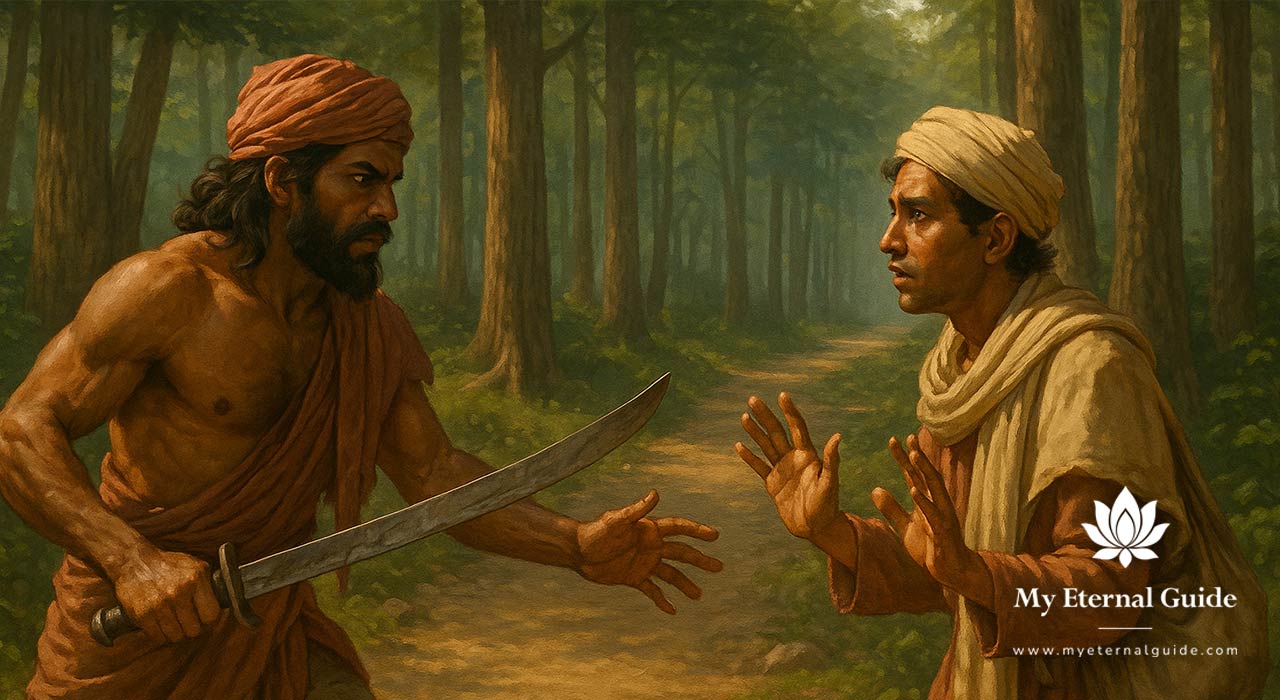
Separated from his family at a young age, Ratnākara was taken in by forest hunters and had to struggle to acquire even the bare basics to survive. Eventually, like many who felt helpless, he slipped into the life of a bandit, stopping travelers and stealing from them, all the while believing that there was no other path available to him.
This part of his life is important because it reflects a common human state – one of confusion. Many of us today may not live in forests or face wild animals, but we do navigate jungles of stress, fear, insecurity and pressure. Ratnākara’s early state of mind mirrors the modern mind which is reactive, restless and craving for stability.
And yet, within Ratnākara and all of us rests a quiet potential, a seed waiting for the right moment to awaken. Every Vedic story reminds us that the Divine does not look at who we have been, but at who we can become. Ratnākara’s journey was about to change through an encounter that would guide him toward the higher truth about his own nature.
The Turning Point: Meeting Nārada Muni
Ratnākara’s life path shifted on a day that began like any other. The forest was dense with the hum of insects and the scent of damp earth. Sunlight filtered through tall sal trees, scattering gold across the pathways. Ratnākara moved through the wilderness with practiced ease. But on that day, something felt different.
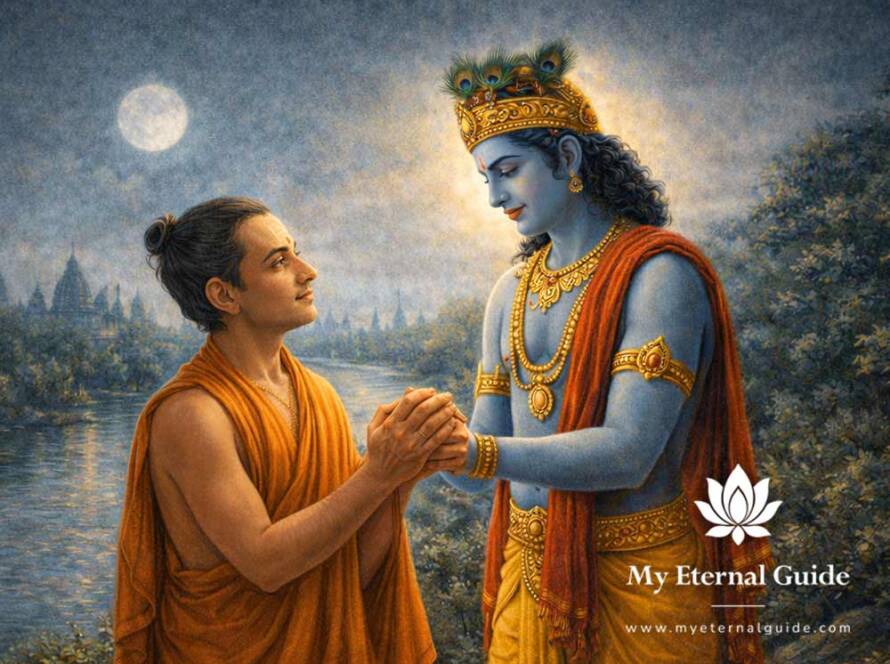
As he stepped onto a small clearing, he saw a radiant figure approaching. The forest itself seemed to fall silent. The figure was Devarishi Nārada, the wandering sage whose presence illuminated even the darkest corners of the world. His veena rested gently in his hand and the serenity on his face carried a grace that felt otherworldly.
Ratnākara had stopped and looted countless travelers before, but this time he did not raise his weapon. Nārada looked towards him with compassion and with no judgement. That compassion disarmed him more effectively than any force could.
Nārada spoke with a voice that felt like flowing water: “Child, why do you walk this path?”
No one had ever asked Ratnākara why. People either feared him or fought him. But this question was different. The question reached somewhere deeper – a place he had never explored.
He replied with sincerity, “I do it for my family. They depend on me.”
Nārada smiled gently. “Then go ask them this: will they share in the fruit of your wrong actions with you? If you walk this path for them, surely they will agree to share in the consequences of your bad action with you.”
The simplicity of the suggestion felt natural. Ratnākara went home. His family greeted him with love, but when he asked whether they would stand with him in the consequences of his wrong choices, they hesitated. They loved him deeply, but each did not agree to do so,.Their answer was tender, yet honest: “We love you, but your choices are your own.”
The truth helped Ratnākara find clarity. A realization dawned: every action shapes the soul of the one who performs it. Families, friends, society may accompany us with love, but the inner evolution of a being is always individual.
The Mantra “Mara… Rama…” — How a Single Sound Became the Doorway to Stillness
When Ratnākara returned to Nārada after speaking with his family, his heart was clear and ready. He bowed deeply before the sage and said with sincerity, “Teach me the path that will purify my life.”
Nārada, who could see into the deepest corners of a seeker’s mind, knew that transformation begins when the inner soil is softened. A mind that is restless needs a mantra that matches its rhythm. And so, with compassion and precision, the sage instructed him:
“Sit here. Close your eyes. Focus on your breath. And chant the name of Rāma.”
Ratnākara tried but the sacred name felt unfamiliar. His tongue stumbled. His breath was uneven. His mind rushed ahead, faster than the mantra.
Seeing this, Nārada placed a hand on his shoulder and offered a path designed specifically for him:
“If ‘Rāma’ feels difficult, begin with ‘Mara.’”
The word mara, meaning to strike or to kill, was a sound rooted in the life Ratnākara once lived. It came naturally to him. The sage knew this. He chose a doorway that Ratnākara’s mind could enter with ease.
Ratnākara began chanting: “Mara… Mara… Mara…”
Slowly, with each repetition, something extraordinary occurred. As the mantra rolled off his tongue in a steady rhythm, the syllables naturally reversed:
Mara… Rama… Mara… Rama…
Without conscious effort, the sacred name of Lord Rāma began to flow through him. His breath aligned with the mantra. His thoughts softened. The forest around him faded into stillness.
This is the heart of Vedic wisdom: When a mantra is given with understanding, even a single word can lift a soul from restlessness to peace.
Ratnākara continued chanting with unwavering focus. Hours dissolved into days, days into nights. The mantra worked quietly within him.
His transformation had begun.
The Anthill — The Birth of Vālmīki
When Nārada left Ratnākara in deep mantra-japa, the forest became his only companion. The mantra “Mara… Rama…” continued to roll effortlessly through his breath. What began as repetition slowly matured into tapas, an intense yet serene state of inner absorption.
Ratnākara sat unmoving, his awareness turned fully inward. Days passed… then months… then years.
In traditional retellings, it is said that during this long meditation, the natural world including wind, rain, insects and time itself, began to settle around him. White ants or valmīka (anthills), slowly built their clay structures over his still body. The body remained where it was but the mind had journeyed into a realm untouched by fear, memory or identity.
His breath did not break. His posture did not change. The mantra continued to flow within him like a quiet river.
Years later, Nārada returned to the forest. The sage, with his divine vision, recognized the mound of earth as the place where Ratnākara sat. He called out gently, “O Ratnākara, rise.”
At that moment, the power of the tapas reached its completion. The structure of the anthill cracked open. Ratnākara emerged, transformed from within, serene, radiant and purified.
Nārada looked upon him with joy and said: “Because you have risen from the valmīka or the anthill, you shall now be known as Vālmīki.”
This moment marks his spiritual rebirth. The man who once wandered the forest with an unsettled mind was now a sage whose presence carried stillness. In the Vedic tradition, such a transformation is not described as miraculous. it is described as the natural flowering of sincere tapas.
Vālmīki’s awakening symbolizes a deeper truth of the yogic path: When the mind becomes still, the true Self emerges. It remains untouched by the past, free from fear and luminous with wisdom.
It was this purified mind – steady and expansive, that would one day give birth to the Rāmāyaṇa, the world’s first epic poem. His journey from Ratnākara to Vālmīki was a preparation for a dharmic task of cosmic significance.
From Ratnākara to Vālmīki: How a Wanderer Became the Author of the Rāmāyaṇa
After emerging from his long tapas and receiving the name Vālmīki, the sage settled into a life of contemplation, teaching and service. His hermitage, located on the banks of the sacred Tamasa River, soon became a sanctuary for seekers, students and sages.
But destiny had an even greater role waiting for him — one that would shape the spiritual consciousness of India for thousands of years to come.
The Moment of Inspiration: A Divine Spark
One early morning, Vālmīki went to the river with his disciple Bharadvāja to perform his daily rituals. The forest was silent, washed in the soft gold of dawn. As they walked along the riverbank, Vālmīki witnessed a scene that would forever change human literature.
Two krauñcha birds, a pair deeply bonded, were singing in joy. Suddenly, a hunter’s arrow struck the male bird. He fell to the ground, writhing. The female bird cried out in grief, her pain filling the air with a sound so raw that even the trees seemed to tremble.
The sage, moved by a surge of compassion, felt something awaken within him. Words flowed from his heart, not as a thought, but as a spontaneous expression of sorrow and dharma:
“Mā niṣāda pratiṣṭhāṁ tvam agamas śāśvatīḥ samāḥ
yad krauñcha mithunād ekam avadhīḥ kāma-mohitam.”
This was no ordinary verse. It was the first śloka in the Sanskrit language, the moment when poetry was born. Vālmīki himself was astonished. How could a deep emotion crystallize into such perfect meter and structure?
Bharadvāja asked in awe, “Gurudeva, what emerged from you was not just grief. It was poetry.”
At that instant, Brahmā, the Creator, appeared before Vālmīki. His presence radiated peace. He spoke gently:
“O Vālmīki, the verse that arose from your compassion was not an accident. You have been chosen to compose the life of Rāma. Exactly as it happened. Nothing will remain hidden from you. The power of divine vision shall be yours.”
This moment, described in the Bāla Kāṇḍa, is the foundation of Vedic literary tradition. Vālmīki did not imagine the Rāmāyaṇa. He saw it through divine insight (dṛṣṭi), as clearly as one sees the world before one’s eyes.
Composing the Rāmāyaṇa: The Journey of a Sage-Poet
Gifted with divine sight, Vālmīki returned to his hermitage and began the monumental task. He composed the 24,000 verses of the Rāmāyaṇa in the exact anuṣṭubh chandas meter that emerged spontaneously from him at the riverbank.
His narration was not only historically accurate according to tradition; it was spiritually crafted to convey dharma, compassion, leadership and inner strength. Each kāṇḍa (book) flowed with clarity and purpose, reflecting a mind that had reached the heights of purity through tapas.
Commentators often say: “Only a purified heart can narrate the life of Rāma.”
Vālmīki’s own journey, from confusion to clarity, from wandering to wisdom, made him the perfect vessel for this divine epic.
Lava and Kuśa: The Legacy Continues
After completing the Rāmāyaṇa, Vālmīki taught it to the young princes Lava and Kuśa, the sons of Rāma and Sītā, who were raised in his āśrama. With their sweet voices and deep innocence, the twins sang the epic for the first time in Rāma’s court .
A Sage Who Transformed the World
Vālmīki’s journey is unique in world literature. He did not become a poet because he was trained in literature. He became a poet because his heart was transformed.
His life is a reminder that:
- A turbulent mind can become a source of wisdom.
- A wandering life can become a guiding light.
- A single transformed soul can uplift countless others.
It was through this inner evolution that Ratnākara became Vālmīki and Vālmīki became the eternal voice of dharma.
For further in-depth reading, explore the full text of the Rāmāyaṇa of Vālmīki (PDF) from a reliable archival source linked here.
Modern-Life Lessons & Practical Guidance from Vālmīki’s Transformation
Vālmīki’s journey is more than a spiritual miracle — it is a map. His life shows us that the mind can be reshaped, the heart can be renewed and destiny can be rewritten at any moment we choose. Below are the most practical and powerful teachings from his story, translated into actions you can apply immediately.
Your Beginning Does Not Decide Your Becoming
Vālmīki’s early life did not limit his future. His transformation began the moment he became aware of his actions and their direction.
Practice:
Write down or think of a belief that limits you (“I’m inconsistent,” “I get overwhelmed”).
Rewrite it the Vālmīki way: “This is where I began — not where I will remain.”
This shifts your inner identity toward growth.
Honest Self-Inquiry is the Gateway to Change
Ratnākara’s awakening began with one question from Nārada: “For whom do you act?”
This dissolved confusion and brought clarity.
Practice:
Every Sunday, take 3 minutes to ask:
- “Why am I choosing this?”
- “What value is guiding me?”
This single habit aligns your life with your true intentions.
Start With What the Mind Can Hold
Nārada didn’t give Ratnākara a lofty practice. He gave him a simple, accessible mantra:
“Mara.” The mind transforms best when the first step is effortless.
Practice:
Choose a 3-minute spiritual habit:
- Chant “Rāma” gently or
- Repeat “Om” with your breath.
Three minutes is enough to build momentum.
Re-train the Mind Through Rhythm
Ratnākara repeated “Mara” until it reversed naturally into “Rāma.”
The sound reshaped his inner world.
Practice: Vālmīki Breath (2 minutes)
- Inhale naturally.
- Exhale with “Rāma…”
- Feel your breath slow down.
This anchors the mind instantly.
Create Stillness in Small Daily Doses
Vālmīki’s stillness created clarity and eventually divine inspiration. While we may not sit for years, we can create micro-stillness daily.
Practice: The 60-Second Pause
Before meals, work or sleep:
- Close your eyes
- Breathe
- Simply be still for one minute
This becomes your modern “anthill” — a place where inner quiet grows.
Transformation Requires a Shift in Inner Climate
Vālmīki’s outer life changed only after his inner atmosphere transformed.
Practice: Weekly Inner Focus
Pick one theme for the week:
- patience
- groundedness
- compassion
- clarity
Observe how it subtly shifts your reactions.
Your Growth Has Ripple Effects
Vālmīki didn’t stop at personal transformation. His inner clarity created the Rāmāyaṇa, uplifting millions.
Practice:
Once a week, share one insight with a loved one. Your journey becomes meaningful when it lights another path.
A Gentle Mantra to Carry Through the Day
Just as Vālmīki carried “Mara… Rama…” through his breath, you can carry a soft mantra to return to calmness anytime.
Practice:
Whenever you feel stressed:
- Pause
- Inhale
- Exhale softly with “Rāma…”
- Continue your activity
This resets your mind without interrupting life.
Make Your Life a Kāvya (A Beautiful Composition)
Vālmīki transformed his experiences into poetry. You can do the same through mindful reflection.
Practice: Weekly Reflection
Write briefly:
- One challenge
- One learning
- One small action you took or will take
This turns life into a meaningful, evolving composition.
Your Past Is Not Your Fate
Vālmīki’s journey reminds us that every life holds an inner doorway waiting to be opened. His transformation did not begin with perfect conditions — it began with a single moment of clarity and the willingness to take one sincere step. When his mind aligned with a higher purpose, everything else followed through grace.
In our own lives, the same possibility exists. Change does not demand a new identity. It only requires a new direction. And even the smallest, most imperfect beginning can lead to profound inner renewal.
If a forest wanderer could become the first poet of the Sanskrit world…
If a restless mind could become a vessel for divine wisdom…
If a single mantra could awaken the deepest stillness…
Then nothing within us is beyond transformation.
Your path, like Vālmīki’s, unfolds the moment you turn inward with sincerity.For personalised guidance, reflections rooted in the Vedas or support for your spiritual questions, you are always welcome at www.myeternalguide.com. You can ask your question anytime – freely, privately and with the assurance that ancient wisdom still speaks to modern lives.
Frequently Asked Questions (FAQs)
2. What is the real story of Ratnākara becoming Vālmīki?
Ratnākara, living a turbulent life as a bandit in the forest, encountered the sage Nārada. Through honest self-inquiry and a mantra practice suited to his mind, he entered deep meditation. Over time, he attained purity of mind and emerged as Vālmīki, a sage who composed The Ramayana.
3. What does the “Mara… Rama…” mantra mean?
Nārada gave Ratnākara the word “Mara,” which reversed naturally into “Rāma,” the name of Lord Rama. This simple yet powerful mantra helped still his mind and anchor him in meditation.
4. What lessons can modern readers learn from Vālmīki’s life?
Vālmīki’s story teaches that your past does not define your future, honest self-reflection leads to clarity and small, sincere spiritual practices can reshape the mind. His journey is a roadmap for anyone seeking inner transformation.
5. How did Vālmīki compose the Rāmāyaṇa?
According to tradition, the spontaneous verse he uttered upon seeing a grieving krauñcha bird became the first śloka in Sanskrit poetry. Brahmā then blessed him with divine insight, enabling him to compose the Rāmāyaṇa exactly as the events occurred.
6. Why is Vālmīki important today?
His life mirrors modern struggles: confusion, emotional turbulence and the search for purpose. Vālmīki shows that with the right guidance, every mind can evolve, regardless of a person’s past.
7. What spiritual practices from Vālmīki’s story can I follow today?
Simple practices such as chanting “Rāma,” mindful breathing, honest reflection and 60-second daily pauses for stillness can help cultivate clarity and emotional balance.
8. Where can I ask questions or get guidance based on Vedic wisdom?
You can ask a spiritual question anytime at www.myeternalguide.com — free, private and available whenever you need support rooted in ancient wisdom.
Vālmīki is revered as the Ādi Kavi, the first poet of Sanskrit literature and the author of the Rāmāyaṇa. His journey from Ratnākara, a forest wanderer, to an enlightened sage makes him one of the most transformative figures in Hindu thought.
Ratnākara, living a turbulent life as a bandit in the forest, encountered the sage Nārada. Through honest self-inquiry and a mantra practice suited to his mind, he entered deep meditation. Over time, he attained purity of mind and emerged as Vālmīki, a sage who composed The Ramayana.
Nārada gave Ratnākara the word “Mara,” which reversed naturally into “Rāma,” the name of Lord Rama. This simple yet powerful mantra helped still his mind and anchor him in meditation.
Vālmīki’s story teaches that your past does not define your future, honest self-reflection leads to clarity and small, sincere spiritual practices can reshape the mind. His journey is a roadmap for anyone seeking inner transformation.
According to tradition, the spontaneous verse he uttered upon seeing a grieving krauñcha bird became the first śloka in Sanskrit poetry. Brahmā then blessed him with divine insight, enabling him to compose the Rāmāyaṇa exactly as the events occurred.
His life mirrors modern struggles: confusion, emotional turbulence and the search for purpose. Vālmīki shows that with the right guidance, every mind can evolve, regardless of a person’s past.
Simple practices such as chanting “Rāma,” mindful breathing, honest reflection and 60-second daily pauses for stillness can help cultivate clarity and emotional balance.
You can ask a spiritual question anytime at www.myeternalguide.com — free, private and available whenever you need support rooted in ancient wisdom.