Vedic Stories | Wisdom From The Vedas
What Happens When the Soul Meets Krishna | Brihad Bhagavatamrita
December 23, 2025 | by Madhura Samarth – Founder, MyEternalGuide
TL;DR: The Brihad Bhagavatamrita, written by Sanatana Goswami, explains the soul’s deepest spiritual journey through the story of Gopa Kumar. As Gopa Kumar travels through heavenly realms, divine domains and states of liberation, he gradually discovers that pleasure, power and even spiritual freedom cannot satisfy the soul’s true longing. Ultimate fulfillment is found only in a personal relationship with Krishna. Culminating in a profound reunion in Goloka Vrindavan, this text teaches a central insight of Gaudiya Vaishnavism – that the soul’s deepest purpose is loving devotion (bhakti) and the Divine responds personally to sincere love rather than spiritual achievement. Each soul is unique and the Lord Krishna is longing for each soul’s return.
At some point in every seeker’s life, often when everything seems outwardly settled, an unexpected question begins to surface. This question may arise after a major achievement or even in moments of gratitude. The question is both simple and unsettling – is this all there is? We try to silence this question by staying busy or by setting new goals, but it keeps coming back. That’s because this question doesn’t come from the mind. It comes from the soul.
The Vedic scriptures explain that this feeling is one of remembrance. The soul is eternal and conscious and its deepest nature is relational. It originates in relationship and seeks relationship. When that connection is forgotten, life continues outwardly, but inwardly something feels unresolved. This is why people who have achieved comfort, success or even spiritual discipline still feel an unnamed longing. The Vedic tradition teaches us that this longing is sacred. It’s the soul’s way of reminding us of who we are and where we belong.
The Brihad Bhagavatamrita begins from this exact emotional space. It starts by taking us through a journey – the journey of Gopa Kumar which reflects the inner movement of every sincere seeker. Gopa Kumar doesn’t begin with clarity or certainty. He begins with love and a sense that life must hold something more precious than what he has ever been able to experience.
When the scriptures say that the soul is eternal, they are offering a deep insight – an eternal being cannot be satisfied by temporary experiences alone. Even achieving noble goals does not satisfy us. This is the reason that the heart continues to ask deeper questions even when one’s material life appears successful.
The question every soul asks is a very personal one. Who knows me completely? Where do I belong without needing to perform? Where does love flow naturally?
The story of Gopa Kumar answers these questions fully. It shows us that the soul’s restlessness has a purpose. This restlessness is guiding us home.
The Brihad Bhagavatamrita assures us that when these soul questions arise, our journey home has already begun.
The Brihad Bhagavatamrita and Who Gopa Kumar Really Is
The story of Gopa Kumar comes to us through the Brihad Bhagavatamrita, a profound devotional text written by Shri Sanatana Goswami, one of the principal acharyas of the Gaudiya Vaishnava tradition. Sanatana Goswami was a philosopher, scholar and realized devotee who understood the inner struggles of seekers. His writings were shaped by his own devotion.
The Brihad Bhagavatamrita was composed with a very specific purpose. It seeks to answer the deepest spiritual question – what does the soul ultimately seek beyond knowledge, liberation and even divine power? Rather than offering a philosophical conclusion, Sanatana Goswami presents a living journey. Through the experiences of a single devotee, his scripture reveals how the soul moves through various stages of realization until it discovers its true home.
Only after establishing this wider spiritual context does the text introduce Gopa Kumar.
Gopa Kumar is not exceptional by worldly or spiritual standards. He is a simple cowherd boy from Vrindavan, raised in an atmosphere of natural devotion and intimacy with Krishna. He has no formal education in the scriptures, no reputation for austerity and no desire for spiritual distinction. What defines him is simply his pure love.
This choice of protagonist is deliberate. Gopa Kumar’s story is driven by longing – a deep longing for Krishna. This longing makes him deeply relatable to modern seekers who may not identify as spiritually accomplished, but still feel a pull toward something higher.
Gopa Kumar represents the devotee whose sincerity outweighs technique. His devotion is not refined. It’s raw and personal. Through him, the Brihad Bhagavatamrita communicates a powerful Vedic truth – Krishna responds to the heart before He responds to qualification.
By choosing such a protagonist, the scripture gently reassures every seeker who feels unworthy or inconsistent. It tells us that love itself is a valid beginning. The journey does not belong only to the learned or disciplined. It belongs to anyone whose heart has turned, even imperfectly, toward Krishna.
Gopa Kumar’s Journey Through the Different Realms
As Gopa Kumar’s journey unfolds in the Brihad Bhagavatamrita, Sanatana Goswami takes the reader through a carefully layered spiritual landscape. Each realm that Gopa Kumar enters represents not only a destination, but a state of consciousness that many seekers pass through, both outwardly and inwardly. The progression is deliberate. It reveals how the soul learns, through experience, what it truly seeks.
Gopa Kumar first encounters realms where material piety is richly rewarded. These are celestial worlds filled with beauty, longevity and refined pleasure. Life here is effortless. Desire is quickly fulfilled. There is admiration, comfort and a sense of earned reward. For many seekers, this stage mirrors the pursuit of a good and moral life. There is satisfaction in doing the right things and enjoying their results. Yet over time, Gopa Kumar senses that pleasure, no matter how elevated, does not deepen the heart. It entertains the senses but leaves the soul unchanged. When enjoyment becomes the goal, love remains secondary.
From these worlds, Gopa Kumar moves into higher heavenly realms governed by powerful devas. Here, order, responsibility and cosmic administration dominate. These realms reflect a stage where seekers are drawn to authority, influence and purposeful action. There is reverence here, but little intimacy. Relationships are defined by position rather than affection. Gopa Kumar feels respect and awe, but he also feels distant. Power creates hierarchy and hierarchy limits closeness. The soul, which longs for equality in love, begins to feel constrained.
As his journey continues, Gopa Kumar reaches realms associated with liberation and transcendence. These abodes are peaceful, still and free from suffering. There is no anxiety, no conflict and no fear of loss. For many seekers today, this state represents the ultimate spiritual ideal. Yet Gopa Kumar discovers something unexpected. Peace without relationships feels silent. There is freedom here, but no exchange. The soul, which is active by nature, begins to feel unseen.
Each of these realms offers something genuine and valuable. The Brihad Bhagavatamrita never dismisses them but it does show their limits. Pleasure satisfies the senses. Power satisfies the ego. Liberation satisfies the desire for relief. None of them satisfy the soul’s longing to love and be loved.
Through these experiences, Gopa Kumar learns what no instruction alone could teach. Fulfillment is not found in elevation, control or escape. It is found in intimacy. This realization prepares him for the final destination, Goloka Vrindavan, where love is not earned or managed, but naturally lived.
Goloka Vrindavan and the Moment Krishna Meets Gopa Kumar
When Gopa Kumar finally arrives in Goloka Vrindavan, it is the time of day that the Vedic texts describe as most intimate and emotionally charged. It is late afternoon moving gently toward evening, the moment known in Vrindavan as the return hour. The sun is soft, low and golden, casting a warm glow across the forests and cow pastures. This is the hour when Krishna returns from the day’s pastimes, when separation ends and closeness begins.
Krishna is already there.
He is walking at the head of the cows, His flute raised to His lips, playing continuously. The flute is never absent in Goloka. It is not an instrument Krishna uses. It is an extension of His heart. The melody flowing from it is not fixed. It changes according to His mood. At this moment, the sound carries a deep sweetness tinged with longing, as though Krishna Himself is calling out for someone specific, someone He has been waiting for.
The sound of that flute reaches Gopa Kumar before anything else does. The moment it touches his heart, he is no longer a traveller. He is no longer a seeker. He is a soul being called home. His body trembles. His breath becomes shallow. He does not move forward. He cannot. The sound itself holds him in place.
Then Krishna sees him.
This moment is described with extraordinary care in the Brihad Bhagavatamrita. Krishna’s flute falls silent instantly. It does not fade out. It stops, as if the flute itself has lost consciousness. Krishna freezes mid-step. His eyes widen. His face changes completely. The joy that floods Him is sudden and overwhelming.
Krishna recognises Gopa Kumar immediately.
This is not recognition based on form or name. It is soul recognition. Krishna knows that one unique soul, whose love He has carried within His heart across time and realms, has finally arrived. The scripture makes it clear that each soul has a distinct, irreplaceable relationship with Krishna and Krishna feels the absence of that soul as real separation.
Overcome with ecstasy, Krishna staggers. His limbs weaken. The flute slips from His hand. For a brief moment, Krishna faints, unable to contain the surge of love and relief. Those around Him rush forward, but before they can reach Him, Krishna regains Himself, driven by urgency rather than composure.
He does not walk toward Gopa Kumar.
Krishna runs.
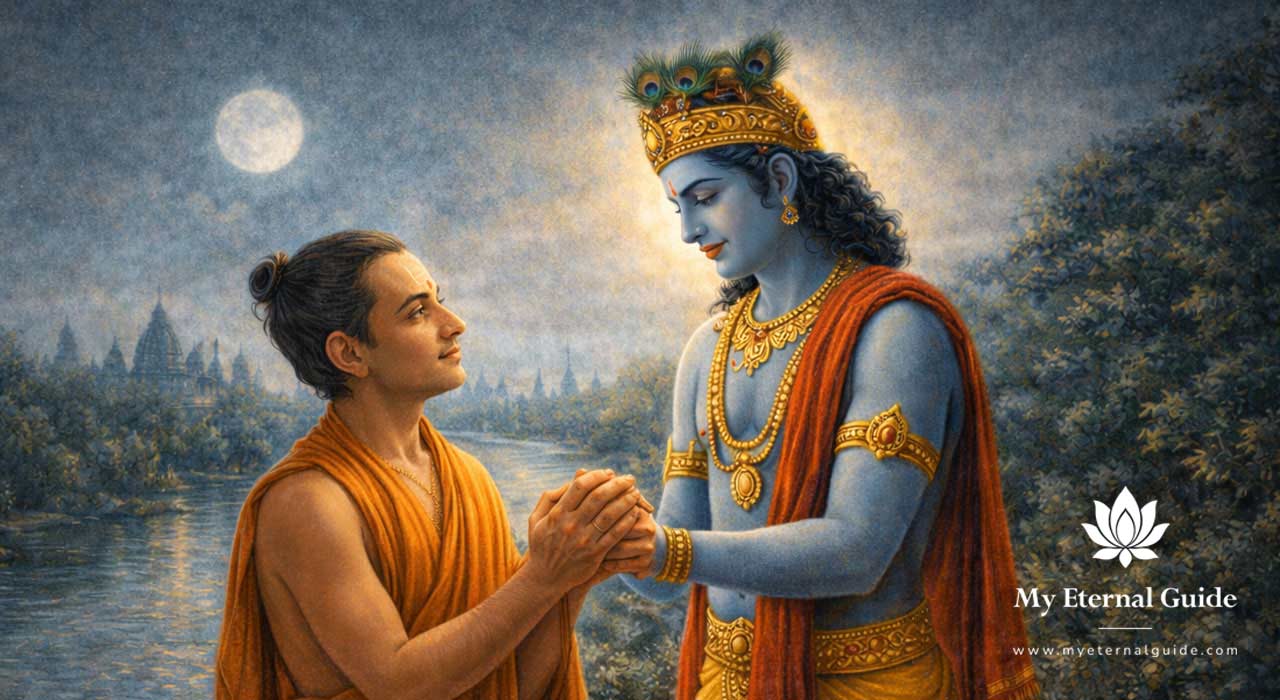
Dust rises beneath His feet as He closes the distance between them. His eyes are fixed only on Gopa Kumar. When He reaches him, Krishna pulls him close with both arms, pressing him to His chest. His body shakes. His voice breaks as He speaks, filled with affection, relief and joy. There is no questioning. No asking where he has been. Only the emotion of reunion.
In that embrace, Krishna communicates a truth that no philosophy can express. He missed him. The journey mattered. The waiting mattered. The soul’s delay was felt.
For modern seekers who fear that their wandering has distanced them from the Divine, this moment changes everything. When the soul finally arrives home, Krishna receives it not as a judge, but as one reunited with someone He never stopped loving.
This is Goloka Vrindavan. Not a destination of achievement, but a meeting of hearts that were never truly separate.
What This Moment Reveals About Krishna
The meeting between Krishna and Gopa Kumar in Goloka Vrindavan is not simply a beautiful devotional scene. It is a theological revelation. Sanatana Goswami uses this moment to show us who Krishna truly is, beyond abstraction, symbolism or distant divinity. What is revealed here reshapes how a seeker understands God, devotion and their own spiritual worth.
First, this moment reveals that Krishna is profoundly personal. He does not relate to souls as a collective mass. Each soul is unique, eternal and irreplaceable to Him. The fact that Krishna recognizes Gopa Kumar instantly and is overwhelmed by his arrival shows that devotion is never anonymous. Every soul carries a distinct flavour of love and Krishna experiences separation from that soul as real absence. This directly counters the modern fear that one is insignificant in the vastness of existence.
Second, this scene reveals that Krishna is emotionally responsive. In many spiritual frameworks, God is imagined as unmoved, unchanged and unaffected. The Brihad Bhagavatamrita presents a radically different vision. Krishna faints in ecstasy. His body reacts. His emotions overflow. In the Vedic understanding, the highest form of the Absolute is one who can love completely.
For modern seekers, this understanding is deeply reassuring. Many people hesitate to approach God honestly because they believe they must be composed, disciplined or perfected. Gopa Kumar’s meeting shows us the opposite. Krishna does not respond to polish. He responds to presence. He responds to the heart that has wandered, struggled and still kept Him within it.
Third, this moment reveals that Krishna values relationship over achievement. Gopa Kumar has travelled through countless realms, yet Krishna does not praise his endurance or progress. None of that is mentioned. What matters is that Gopa Kumar has arrived as himself, unchanged in his essential love. This teaches that the spiritual journey is not about becoming someone else. It is about returning as who you truly are.
Finally, this meeting reveals that Krishna has been waiting. The waiting is mutual. While the soul searches across worlds, Krishna holds space. He does not abandon the soul during its wandering. He remembers. He anticipates. When reunion happens, it is not one-sided. It is shared relief.
This is the Krishna revealed by the Brihad Bhagavatamrita. A Krishna who is deeply, eternally involved in the journey of every soul.
An Invitation
If something within you responded while reading this, allow that response to matter. The Vedic tradition reminds us that resonance is never accidental. When a story stays with us, it is often because it is speaking to something already alive within the heart.
The journey of Gopa Kumar can be lived inwardly by us too. Each seeker arrives at different moments of longing, doubt or readiness. Guidance becomes meaningful when it meets us exactly where we are.
If you feel drawn to explore further, spend time with the Brihad Bhagavatamrita itself. A reliable English translation by Gopiparanadhana Dasa is available through the Bhaktivedanta Book Trust.And when questions arise, as they naturally do on any sincere path, you are always welcome to ask at www.myeternalguide.com. You can ask a question for free, anytime you feel uncertain, reflective or simply curious. Sometimes, the right guidance at the right moment is enough to help the next step reveal itself.
Frequently Asked Questions (FAQs)
2. What is the Brihad Bhagavatamrita about?
The Brihad Bhagavatamrita is a devotional scripture that explains the soul’s journey through various realms of existence to discover its true fulfillment in loving relationship with Krishna. It shows why pleasure, power and even liberation are incomplete without intimacy with the Divine.
3. Why does Gopa Kumar feel unfulfilled in higher spiritual realms?
Gopa Kumar feels unfulfilled because higher realms offer pleasure, power or peace, but not personal relationship. According to the Brihad Bhagavatamrita, the soul’s deepest need is to love and be loved, which only finds fulfillment in direct relationship with Krishna.
4. What is Goloka Vrindavan according to the Brihad Bhagavatamrita?
Goloka Vrindavan is the eternal spiritual realm where Krishna lives in intimate relationship with His devotees. It is described as the soul’s true home, where love flows naturally and belonging does not need to be earned.
5. Why does Krishna faint when He sees Gopa Kumar?
Krishna faints in ecstasy because each soul has a unique and irreplaceable relationship with Him. In the Brihad Bhagavatamrita, Krishna feels the absence of a soul as real separation, and Gopa Kumar’s arrival overwhelms Him with joy and relief.
6. What does Krishna’s reaction reveal about God in the Vedic tradition?
Krishna’s reaction reveals a deeply personal and emotionally responsive God. Unlike impersonal concepts of the Divine, the Vedic tradition presents Krishna as one who loves fully, remembers each soul and responds to devotion with affection.
7. What lesson does Gopa Kumar’s story offer modern seekers?
Gopa Kumar’s story teaches that sincerity matters more than spiritual perfection. It reassures modern seekers that wandering, doubt and delay do not diminish divine love, and that the soul is always remembered by Krishna.
8. Is the story of Gopa Kumar symbolic or literal?
Within Gaudiya Vaishnavism, the story of Gopa Kumar is understood as spiritually real while also offering deep psychological insight. It functions as both theology and guidance for the inner life of the seeker.
9. How can the Brihad Bhagavatamrita help someone today?
The Brihad Bhagavatamrita helps modern seekers understand their restlessness, longing and search for meaning. It reframes spiritual life as a journey toward relationship rather than achievement and offers reassurance that the soul’s longing has purpose.
Gopa Kumar is a simple cowherd boy from Vrindavan whose spiritual journey is described in the Brihad Bhagavatamrita by Shri Sanatana Goswami. He represents the sincere seeker whose devotion is driven by love rather than knowledge, discipline or spiritual status.
The Brihad Bhagavatamrita is a devotional scripture that explains the soul’s journey through various realms of existence to discover its true fulfillment in loving relationship with Krishna. It shows why pleasure, power and even liberation are incomplete without intimacy with the Divine.
Gopa Kumar feels unfulfilled because higher realms offer pleasure, power or peace, but not personal relationship. According to the Brihad Bhagavatamrita, the soul’s deepest need is to love and be loved, which only finds fulfillment in direct relationship with Krishna.
Goloka Vrindavan is the eternal spiritual realm where Krishna lives in intimate relationship with His devotees. It is described as the soul’s true home, where love flows naturally and belonging does not need to be earned.
Krishna faints in ecstasy because each soul has a unique and irreplaceable relationship with Him. In the Brihad Bhagavatamrita, Krishna feels the absence of a soul as real separation, and Gopa Kumar’s arrival overwhelms Him with joy and relief.
Krishna’s reaction reveals a deeply personal and emotionally responsive God. Unlike impersonal concepts of the Divine, the Vedic tradition presents Krishna as one who loves fully, remembers each soul and responds to devotion with affection.
Gopa Kumar’s story teaches that sincerity matters more than spiritual perfection. It reassures modern seekers that wandering, doubt and delay do not diminish divine love, and that the soul is always remembered by Krishna.
Within Gaudiya Vaishnavism, the story of Gopa Kumar is understood as spiritually real while also offering deep psychological insight. It functions as both theology and guidance for the inner life of the seeker.
The Brihad Bhagavatamrita helps modern seekers understand their restlessness, longing and search for meaning. It reframes spiritual life as a journey toward relationship rather than achievement and offers reassurance that the soul’s longing has purpose.