
Guilt & Forgiveness in the Vedas

Guilt doesn’t always remain in the past. It stays on in the mind.
Guilt appears in silence and returns when we least expect it. Over time, it can make us feel like peace is completely out of reach. The Vedas, including texts like the Bhagavad Gita and the Upanishads, offer deep insight into human emotions like guilt and offer a clear way forward. If you’re here, you may be asking:
- Can I forgive myself?
- Will karma punish me?
- What should I do about what I’ve done?
According to Vedic thought, guilt is meant to guide you back to alignment rather than to trap you in negativity. This page brings together timeless wisdom from the Vedic texts to help you understand:
- What guilt really is
- How to respond to guilt
- How to move forward with clarity
Start here
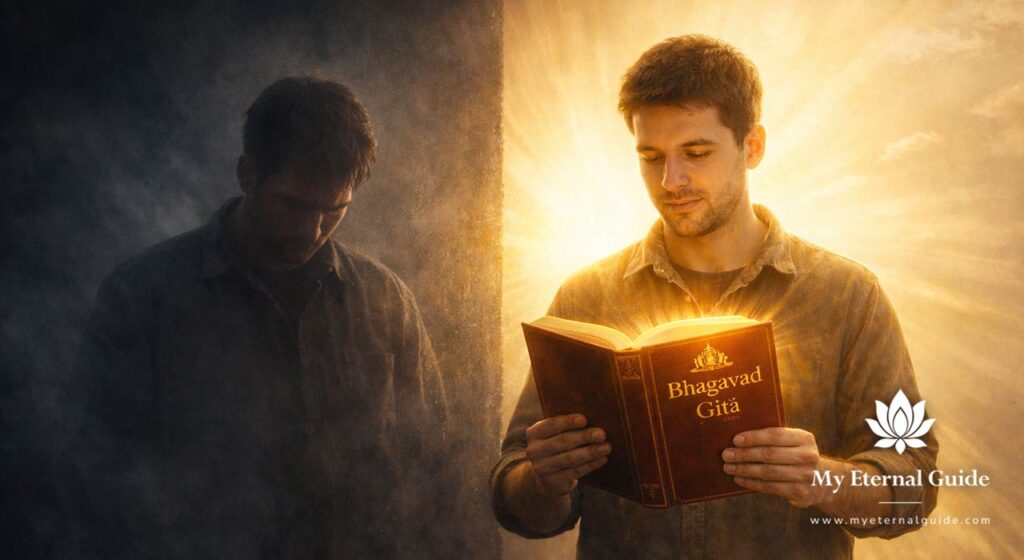




What is guilt in Hinduism?
In Vedic philosophy, guilt is a signal or a recognition that an action was not in harmony with dharma (right conduct).
The Bhagavad Gita repeatedly points toward self-awareness and right action and specifically leads us away from self-condemnation. The Gita holds that guilt serves a purpose because it leads to reflection, correction and realignment. But when guilt turns into endless self-blame, it loses its purpose.
👉 To understand this concept more clearly:
→ What does the Bhagavad Gita say about guilt?
#what-is-guilt
Does karma mean you will be punished?
A common fear is: “Something bad will happen to me because of what I’ve done.”
In Vedic thought, karma is a perfect system of cause and effect. Our actions create impressions and consequences, but at the same time they also create opportunities for correction and growth.
👉 If this question resonates with you read the blog below:
→ Does karma mean I will be punished?
#karma
How to forgive yourself
Self-forgiveness is often the hardest part. And that’s not because it is impossible but because the mind keeps returning to the past. In dharmic living, forgiveness is about:
- Seeing clearly
- Learning fully
- Choosing differently
You don’t forget or ignore what has happened but you do find a way to move forward.
👉 If you’re struggling with this emotion:
→ Can I forgive myself for lying?
#forgive-yourself
How to make things right (Atonement)
Vedic tradition offers a simple and practical way to move forward:
Prāyaścitta (atonement) is the process of restoring balance through:
- Acknowledgement
- Corrective action
- inner discipline
This means:
👉 You can let go of guilt over time
👉 You are meant to resolve your feeling consciously
Learn how this works in practice:
→ Is there a way to atone for past mistakes?
#atonement
What if you hurt someone you love?
Guilt feels most intense when you hurt someone you love. The path forward has three concrete steps:
- Taking responsibility
- Communicating honestly
- Repairing Consistently
Avoiding the situation often makes us feel worse. Right action begins to reduce the burden of guilt.
👉 If this reflects your situation:
→ I hurt someone I love. What should I do now?
#hurt-someone
Why guilt keeps coming back
Even after a long time has passed, our feelings of guilt can come back in waves.
This happens when:
- The mind keeps replaying the event
- There hasn’t been any closure
- The underlying pattern has not changed
👉 Many times, what feels like anxiety or overthinking is actually unresolved guilt.
→ Explore this here.
A simple way to move forward
Instead of staying in: “Why did this happen?”
Ask: “What is the right action now?”
Every fresh moment gives you:
- A chance to move forward
- A chance to restore peace
- A chance to act with clarity
Still grappling with a situation or emotion you can’t resolve?
You don’t have to figure it out alone.
You will receive guidance rooted in timeless wisdom, applied to your personal situation.
Related Questions
You might also be wondering:

In Hindu philosophy, guilt is a signal that an action was not aligned with dharma. It becomes useful when it leads to reflection, correction and realignment.
Karma is a system of cause and effect. Actions create consequences and impressions, but they also create opportunities for correction, growth and conscious change.
In dharmic living, self-forgiveness comes through clear seeing, sincere learning and choosing differently going forward rather than remaining trapped in self-condemnation.
Prāyaścitta, or atonement, is the process of restoring balance through acknowledgement, corrective action and inner discipline.