
How Do Karma and Consciousness Affect What Comes Next?
May 11, 2026 | By Madhura Samarth and Layla Nathwani
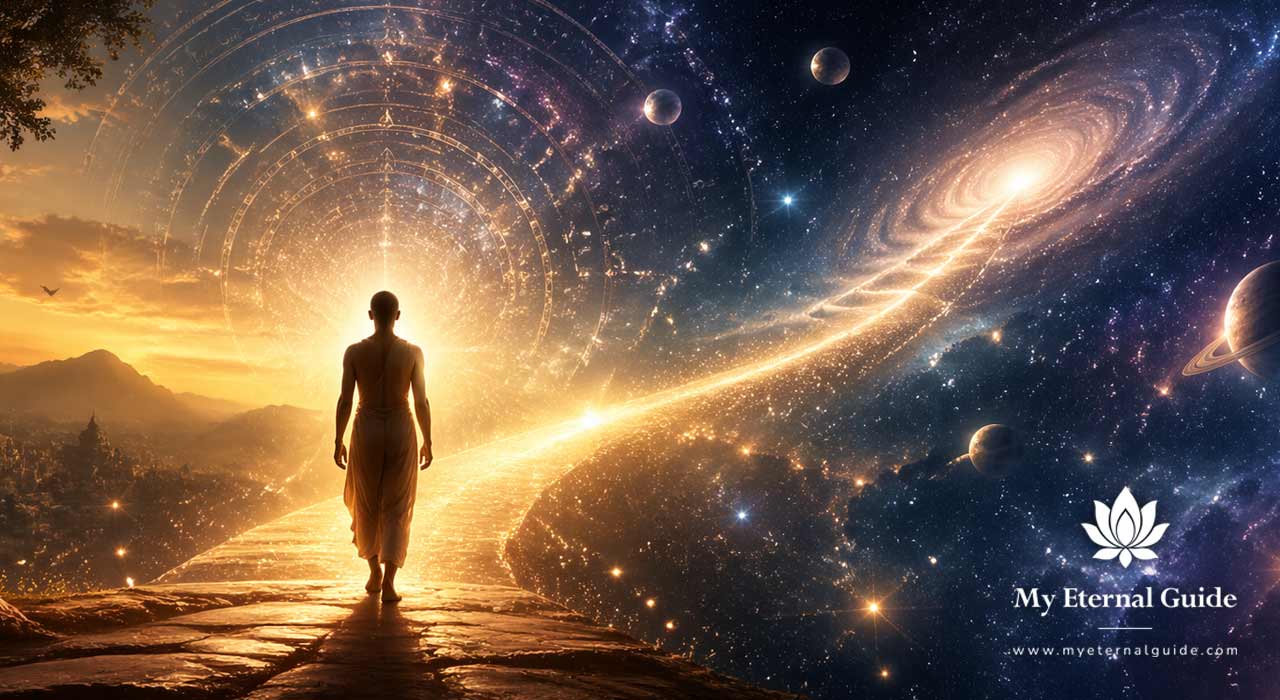
Karma shapes the circumstances that appear in our lives, while consciousness determines how we experience and respond to them. Together, they determine what unfolds next in this life and beyond. When we act with awareness, our actions align with dharma (right action), leading us toward clarity, peace and ultimately liberation.
Scriptural Verse
The Bhagavad Gita (8.6) says:
“Whatever state of being one remembers when he quits his body, that state he will attain without fail.”
This verse reveals that our final state of consciousness reflects a lifetime of karma and determines what comes next.
Understanding Karma and Consciousness Through the Vedic Lens
In the Vedic worldview, karma and consciousness are inseparable. Karma refers to action and the subtle imprint each action leaves. Consciousness refers to awareness, intention and our inner state. When we combine both these aspects, we begin to see life as a continuous flow.
Every action we take leaves an imprint in the field of existence. Think of every action like a seed that you’ve sown. Some seeds sprout immediately, while others take time. Consciousness acts like the soil in which these seeds grow. When our awareness is clear, even difficult karmas in the form of life situations, can transform into opportunities for growth and transformation.
The Upanishads explain that consciousness is the bridge between the individual self and universal truth. This means that the people, events and situations that come into our lives are not random. They follow a precise and intelligent pattern guided by both our past actions and our present awareness.
A Story from the Scriptures: King Bharata’s Journey Across Lives
To truly understand how karma and consciousness shape what comes next, let us reflect on the story of King Bharata from the Srimad Bhagavatam.
King Bharata was a great ruler who renounced his kingdom in pursuit of spiritual realization. He lived in the forest, deeply absorbed in meditation and devotion. His consciousness had reached a high state of purity.
One day, he found a young deer whose mother had died. Out of compassion, he began caring for the deer. Over time, his attachment to the deer grew stronger. His meditation reduced, and his thoughts became centered around the deer’s well-being.
At the time of his death, his mind was filled with concern for the deer. As the Bhagavad Gita verse explains, his final thought shaped what came next. He was reborn as a deer.
However, due to his previous spiritual progress, he retained awareness from his past life. In his next human birth, he lived as Jada Bharata, completely detached and deeply aware. This time, he ensured that his consciousness remained anchored in truth, leading him toward liberation.
This story teaches us that karma alone does not decide our future. Consciousness at the moment of transition plays a decisive role. Even a spiritually advanced person can be redirected by attachment, while awareness at the last moment of our life can lift us beyond cycles of rebirth.
How Karma Shapes What Comes Next
Karma is often misunderstood as punishment or reward. The Vedas say, though, that karma is a system that helps us learn and come into alignment with the universe.
Let’s understand how we create karma:
Every action leaves behind a subtle impression, called a samskara. Over time, these impressions build up and shape how we think, feel and respond to life. In many ways, this becomes our conditioning. That is why certain patterns keep repeating in our lives.
There are three types of karma described in Vedic texts:
- Sanchita Karma: The accumulated karma from past lives
- Prarabdha Karma: The portion currently unfolding
- Agami Karma: The karma we are creating now
What comes next in our lives depends on how these karmas interact with our current consciousness. For example, two people may face the same challenge. One responds with anger, creating more karmic entanglement while the other responds with understanding, dissolving karmic entanglement. The external situation may be similar but the internal journey leads to completely different outcomes.
How Consciousness Directs the Outcome
Consciousness is the master key in the Vedic framework. While karma sets the stage, consciousness decides how the play unfolds.
The Mandukya Upanishad describes consciousness as the ultimate reality. When we raise our awareness, we begin to act from clarity rather than from our past conditioning.
This change in perspecting has powerful effects:
- We respond instead of reacting
- We act with intention instead of impulse
- We align with dharma instead of desire
Over time, our new way of being transforms our karmic trajectory.
Modern research also explores the role of consciousness in shaping reality. You can explore the academic this perspective on how awareness influences behavior patterns: https://plato.stanford.edu/entries/consciousness/
When we combine ancient wisdom with modern understanding, we begin to see that consciousness refines karma and karma reflects consciousness.
Practical Steps to Align Karma and Consciousness
The beauty of Vedic wisdom lies in the fact that it is so practical. We can begin transforming our lives through simple, consistent actions.
1. Practice Daily Awareness
Observe our thoughts and actions without judgment. Awareness itself begins the process of transformation.
2. Act with Intention
Before taking action, pause and ask yourself if the action you are about to take aligns with your higher values. This shift helps you shape karma consciously.
3. Cultivate Detachment
Engage fully in performing the right action while releasing attachment to the result. This attitude reduces karmic binding.
4. Meditate Regularly
Meditation refines consciousness. Even a few minutes daily can create profound change over time.
5. Reflect on Your Actions
At the end of the day, review your actions. This helps us learn and evolve continuously.
6. Seek Knowledge from Authentic Sources
Deepen your understanding through trusted texts and teachings. For example, the teachings of the Bhagavad Gita are beautifully explained in resources like Swami Mukundananda’s Bhagavad Gita: https://www.holy-bhagavad-gita.org/
Think about this question – If your current state of consciousness shapes what comes next, what small shift can you make today to align your thoughts, actions and intentions more closely with your higher self?
If this blog topic resonates with you, you can explore it more in depth by asking your own questions and clearing your doubts at chat.myeternalguide.com. The right guidance often appears at the moment we need it most.
Related Articles
To explore more on this topic, you can go through the blogs below.
- Does karma mean punishment
- How to calm the restless mind
- What is dharma in Hinduism
- What happens when the soul meets Krishna?
Frequently Asked Questions (FAQs)
2. Does karma alone decide our future?
Karma influences our circumstances but consciousness determines how we respond. A higher state of awareness can transform karmic outcomes significantly.
3. How does our consciousness at death affect rebirth?
According to the Bhagavad Gita, the state of mind at the time of death shapes the next phase of existence. Our consciousness at death reflects a lifetime of thoughts and actions.
4. Can we change our karma?
We can transform our karmic path by acting consciously, practicing awareness and aligning with dharma. Our present actions shape future outcomes.
5. What practices improve consciousness?
Meditation, self-reflection, mindful action and studying Vedic wisdom all contribute to raising our level of consciousness.
Karma represents our actions and the consequences that follow, while consciousness reflects our awareness and intention. Together, these two factos determine how we experience life and what unfolds next.
Karma influences our circumstances but consciousness determines how we respond. A higher state of awareness can transform karmic outcomes significantly.
According to the Bhagavad Gita, the state of mind at the time of death shapes the next phase of existence. Our consciousness at death reflects a lifetime of thoughts and actions.
We can transform our karmic path by acting consciously, practicing awareness and aligning with dharma. Our present actions shape future outcomes.
Meditation, self-reflection, mindful action and studying Vedic wisdom all contribute to raising our level of consciousness.
