
How Gratitude Changes Your Karma and Your Mindset
July 23, 2026 | By Madhura Samarth and Layla Nathwani
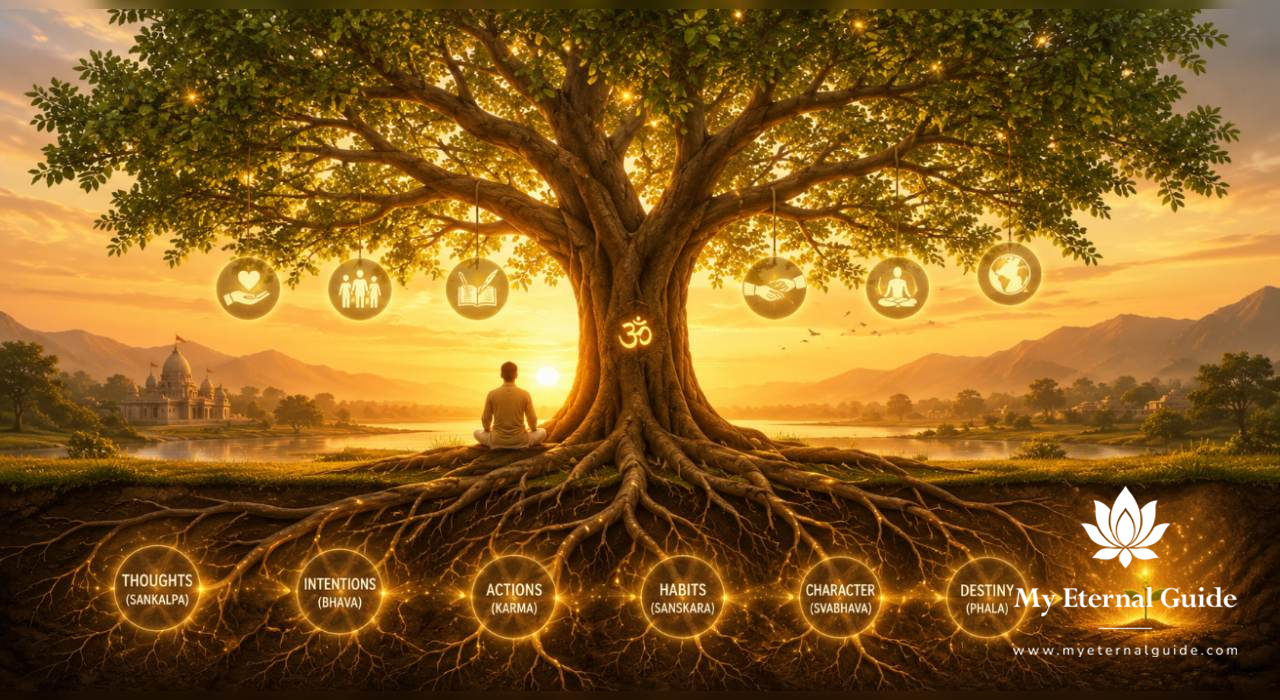
TL;DR: Gratitude changes your karma by changing the quality of your thoughts, intentions, words and actions. In Vedic wisdom, karma means action and the consequences created through action. When gratitude becomes a regular inner practice, it encourages generosity, humility, contentment and thoughtful choices. These qualities create healthier samskaras, or mental impressions, which gradually reshape your mindset and influence the karma you create in the present.
Gratitude may not be able to change past events but it can completely transform the way you respond to them. That response becomes your present karma and helps shape your future.
Why Gratitude Is More Than Saying Thank You
Most people understand gratitude as appreciation for something pleasant. We feel grateful when we receive help, achieve a goal, recover from an illness or spend time with someone we love.
In the Vedic tradition, gratitude is a way of seeing life. It is the recognition that our existence depends upon countless visible and invisible contributions. Our food comes through soil, rain, sunlight, farmers, transporters and cooks. Our knowledge comes through parents, teachers, books, experience and the accumulated wisdom of generations. Even our ability to take the next breath depends upon forces that are far beyond our control.
When we become conscious of this interdependence, we don’t feel as entitled as we did before. Life becomes less like a collection of possessions and more like a sacred trust. This shift matters because when we are entitled we ask, “Why have I received so little?” When we feel grateful we ask, “How shall I use what I have received?” The second question naturally leads to wiser decisions which lead to better karma.
What Does Gratitude Mean in Vedic Wisdom?
The Sanskrit tradition contains several ideas connected with gratitude, including kritajñatā, which can be understood as recognising what has been done for us. This word has embedded within it, an important insight. Gratitude begins with memory. We remember the people, circumstances and forms of grace that have supported our journey.
The Taittiriya Upanishad says: “Mātṛ devo bhava. Pitṛ devo bhava. Ācārya devo bhava. Atithi devo bhava.”
See the sacred in your mother. See the sacred in your father. See the sacred in your teacher. See the sacred in your guest. This Vedic teaching creates a culture of appreciation. It asks us to remember the sources from which care, guidance and opportunity have come.
Gratitude in the Vedic worldview is therefore expressed through conduct. Respecting parents, honouring teachers, welcoming guests, caring for nature, sharing food and serving society are all forms of gratitude.
What Is Karma?
Karma is frequently described as a system of reward and punishment. This interpretation captures only a small part of its meaning. The Sanskrit word karma means action. It includes physical actions, speech, mental choices and the intention behind our actions.
Every action has an outer effect and an inner effect. When you speak kindly, your words affect another person. They also strengthen kindness within you. When you react with resentment, your response affects the relationship and strengthens the habit of resentment in your own mind.
This inner residue is called a samskara. Samskaras are impressions created through repeated thoughts, emotions and actions. Over time, they influence how we perceive situations and how we respond to them. Karma therefore shapes circumstances, character and consciousness.
For a deeper explanation of how present effort interacts with karmic conditions, read What Do Karma and Effort Have to Do With Our Financial Life?.
How Does Gratitude Change Your Karma?
Gratitude influences karma through a clear sequence:
Perception creates thought. Thought influences intention. Intention guides action. Repeated action forms character. Character shapes future choices.
Imagine that two people receive the same opportunity.
One person sees the opportunity as something they deserve. They may use it carelessly or seek greater personal advantage. The other person sees the opportunity as a gift which brings with it responsibility. They may work sincerely, acknowledge those who helped them and use their success to benefit others. The outer opportunity is similar. The inner response creates different karma.
Gratitude changes the motive behind action. It moves us from consumption towards stewardship, from comparison towards contentment and from self absorption towards contribution.
Gratitude changes the karma of speech
A grateful person becomes more aware of encouragement, appreciation and acknowledgement.
Their speech begins to include phrases such as:
“Your help made a difference.”
“I value what you have done.”
“I have learned from you.”
“Thank you for being present.”
These words strengthen relationships and create an atmosphere in which goodness is recognised.
Gratitude changes the karma of action
Appreciation often inspires reciprocity. Someone who feels grateful for education may support another student. A person who appreciates family care may become more attentive to elderly parents. Someone who recognises the value of nature may consume more thoughtfully. Gratitude therefore becomes seva, or service.
Gratitude changes the karma of intention
The same action can be carried out with different intentions.
A donation may be made for praise, social status, guilt, duty or genuine compassion. The visible act appears similar, while the inner karma differs. Gratitude purifies intention because it encourages giving from abundance of heart.
Can Gratitude Change Past Karma?
Vedic teachings describe karma through 3 categories:
- Sanchita karma refers to one’s accumulated karma.
- Prarabdha karma refers to the portion that’s already unfolding through present circumstances.
- Agami karma refers to karma being created through one’s current choices.
Gratitude works most directly upon your present response and your agami karma. You may inherit a difficult circumstance through prarabdha karma. Gratitude can help you meet that circumstance with patience, wisdom and courage. Through that response, you create a different inner impression and a healthier future direction. The past event is still part of your story but its psychological and spiritual meaning can evolve.
This is one reason two people can emerge from similar hardship with very different mindsets. One may become bitter while another may become compassionate. Their circumstances influenced them, while their repeated responses shaped who they became. Gratitude gives us a way to participate consciously in that process.
How Gratitude Changes Your Mindset
Your mindset is determined by where you repeatedly focus your attention. A mind trained in complaint searches for omissions, disappointments and unfairness. Even during a pleasant day, it discovers the few elements that might be missing.
A mind trained in gratitude searches for support, meaning, learning and possibility. Even during a challenging day, it notices what is valuable. This mindset has little to do with pretending that everything feels pleasant.
Gratitude broadens our perception so that pain becomes one part of reality rather than the whole of reality. You may feel worried about work and grateful for a supportive colleague. You may grieve a loved one and feel grateful for the years you shared.
You may face financial pressure and appreciate the skills, relationships and opportunities still available to you. Gratitude allows several truths to coexist.
If your anxiety continues even when life appears secure, the article Why You Feel Insecure Even When Life Seems Stable explores how old samskaras affect present perception.
Gratitude Creates New Samskaras
Every repeated thought makes a mental pathway more familiar. Suppose you end each day thinking that nothing went well. Your mind will gradually become skilled at finding evidence for disappointment.
Now suppose, instead, you think about the help you received or new learnings you had or who supported you or what opportunity a difficulty revealed, your mind will move in a better direction. It begins to form different associations. Appreciation becomes easier to access because you have been practicing it.
This is the Vedic logic behind daily spiritual disciplines. Repetition turns a chosen thought into a samskara. The samskara influences future reactions. Future reactions create further karma.
Gratitude therefore changes mindset through disciplined repetition rather than momentary inspiration.
Gratitude Increases Sattva
Vedic philosophy describes nature and the mind through three gunas.
- Tamas is associated with inertia, heaviness and dullness.
- Rajas is associated with restlessness, craving and constant activity.
- Sattva is associated with clarity, balance, harmony and wisdom.
Gratitude encourages sattva because it reduces the nagging feeling that we must get more out of life before we can feel complete.
When we are in the mode of Rajas we will feel that we will become peaceful when we acquire the next thing. In the mode of Tamas, we feel that nothing meaningful is available to us. When we are in the mode of Sattva, we can see what we have in front of us, use it wisely and continue growing.
The Bhagavad Gita 17.16 describes serenity of mind, gentleness, self control and purity of intention as forms of mental discipline. Gratitude supports each of these qualities. A sattvic mind still has goals. It pursues them with clarity instead of desperation.
Gratitude Reduces Comparison
Comparison narrows our field of attention. It places another person’s visible success alongside our private struggle and reaches a conclusion based on incomplete information.
We see their achievements but we miss seeing their sacrifices. We see their celebrations and overlook their uncertainty. We compare our entire life with one edited moment from theirs.
Gratitude brings attention back to our own dharma. Instead of asking, “Why is their path moving faster?” we begin asking: “How can I make the best use of my own abilities?”
“What is the right action for my present stage of life?”
Gratitude turns comparison into responsibility.
When the mind becomes confused by competing expectations. How Do We Deal With Confusion in Life? offers a Vedic framework for returning to dharma and clarity.
Gratitude Loosens Greed and Attachment
Greed grows through the belief that fulfilment is always found in the next possession, achievement or experience. Gratitude interrupts that cycle by teaching the mind to be content.
Practicing gratitude does not require abandoning ambition. It allows ambition to become healthier. A grateful person can seek prosperity, professional growth and a comfortable life. Their peace has a deeper foundation than constant acquisition. They can enjoy what comes their way while remembering the temporary nature of all material achievements.
The first verse of the Isha Upanishad invites us to see the universe as pervaded by the Divine and to enjoy life through a spirit of renunciation. This can be understood as stewardship. We receive, enjoy, care for and eventually release. Gratitude supports this relationship with the world. Possessions become resources rather than identity.
Read How Do We Overcome Greed and Attachment? for a deeper exploration of contentment, ownership and inner freedom.
Krishna and Sudama: Gratitude Sees the Heart
The story of Krishna and Sudama offers a beautiful picture of gratitude. Sudama, Krishna’s childhood friend, lived in poverty. When he visited Krishna, he carried a humble gift of flattened rice. Sudama felt embarrassed by the simplicity of his offering.
Krishna received him with affection and joy. He welcomed Sudama personally, honoured him and accepted the rice as if it were rare and precious. The story shows that gratitude recognises bhava or the feeling behind an offering. The market value of the gift was small. The love within it was immeasurable.
Sudama also approached Krishna with remembrance rather than entitlement. He valued the friendship itself. Krishna responded with generosity.
This story changes how we understand abundance. Wealth alone cannot determine richness. A simple offering made with devotion can carry profound spiritual value.
Gratitude trains us to see the intention behind what others give. A meal, a phone call, a prayer, a few minutes of attention or a sincere effort may contain more love than its outer form reveals.
Queen Kunti and Gratitude During Hardship
Queen Kunti’s life in the Mahabharata included danger, exile, political conflict and constant uncertainty. Her prayers to Krishna reveal an advanced form of gratitude. She recognised that the hardships she faced had increased her remembrance of the Divine.
Kunti was neither praising suffering nor seeking helplessness. She was recognising that a painful experience had produced spiritual insight, courage and closeness to Krishna. This approach is retrospective gratitude. It often emerges after we have travelled through a difficult period and can finally see what it taught us:
- Perhaps hardship clarified your values.
- Perhaps disappointment redirected your path.
- Perhaps loneliness helped you recognise a meaningful relationship.
- Perhaps failure humbled you and strengthened your discipline.
Gratitude allows suffering to bring with it wisdom.
What Science Says About Gratitude
Modern research increasingly supports the idea that gratitude can influence our emotional wellbeing.
A systematic review and meta analysis of gratitude interventions found associations with greater life satisfaction, improved mental health, more positive emotions and fewer symptoms of anxiety and depression. The researchers also observed outcomes such as optimism, prosocial behaviour and reduced worry. You can read the study through the United States National Library of Medicine’s PubMed Central.
Harvard Health Publishing has also reviewed research connecting gratitude with emotional and social wellbeing, sleep quality and other measures of health. It describes practical exercises such as gratitude questions, family conversations, thank you letters and mindful appreciation. Read the full Harvard Health article on gratitude and wellbeing.
These findings confirm that what we repeatedly focus on influences our emotional habits. Vedic wisdom adds another dimension. Gratitude supports psychological wellbeing while also purifying intention, strengthening dharma and improving the quality of our actions.
Is Gratitude Is Compatible With Pain?
A mature gratitude practice gives pain a compassionate place. You can appreciate your family and still need stronger boundaries. You can value your work and still seek a healthier role. You can feel grateful for life and still experience grief. You can recognise a lesson while allowing healing to unfold gradually. Gratitude becomes harmful only when it is used to silence honest emotion or excuse harmful behaviour. Authentic gratitude begins with truth.
The Bhagavad Gita begins with Arjuna expressing his distress openly and honestly. Krishna guides him after listening to his confusion. The spiritual journey begins through honest awareness. Gratitude adds perspective to pain.
For support with memories that continue to create guilt or regret, read How to Let Go of Guilt and Regret Through Vedic Wisdom.
Gratitude Turns Daily Life Into an Offering
In Bhagavad Gita 9.27, Krishna teaches Arjuna to offer whatever he does, eats, gives and practises to the Divine.
This verse helps transform our ordinary duties and actions. For example:
- Cooking for your family can become an offering.
- Working honestly can become an offering.
- Caring for your body can become an offering.
- Sharing knowledge can become an offering.
- Resting responsibly can become an offering.
When actions are offered to the divine, life feels less difficult. Spirituality moves beyond a particular ritual or hour of the day and every duty can bring with it remembrance. Gratitude is the bridge between receiving and offering. We recognise what has been given and we ask how it can be used well.
A Seven Day Vedic Gratitude Practice
Day 1: Gratitude for the body
Sit quietly and acknowledge three ways your body supports you. Thank your eyes, hands, breath, heart or legs.
Choose one action that honours the body, such as nourishing food, movement or sufficient rest.
Day 2: Gratitude for people
Write down the names of three people who contributed to your life.
Send one person a sincere message describing exactly what you appreciate.
Specific gratitude carries greater emotional depth than a general thank you.
Day 3: Gratitude for food
Before eating, pause for a few breaths.
Remember the soil, rain, sunlight, farmers, sellers and cooks involved in bringing the food to you.
Receive the meal as prasada, a sacred gift, and eat with awareness.
Day 4: Gratitude for a lesson
Think of one recent difficulty.
Ask, “What quality is this situation helping me develop?”
Possible answers include patience, discernment, courage, humility or stronger boundaries.
Day 5: Gratitude through seva
Convert appreciation into action.
Help someone, share food, support a meaningful cause, call an elderly relative or offer your skills without seeking recognition.
This is gratitude becoming karma yoga.
Day 6: Gratitude for sufficiency
Observe one desire that repeatedly creates restlessness.
Say inwardly, “I appreciate what is present while I work wisely towards growth.”
This combines contentment with purposeful action.
Day 7: Offer your actions
At the beginning of the day, mentally offer your work to the Divine.
At night, review the day without harsh judgment.
Give thanks for what went well. Learn from what could improve. Release the results.
Three Questions to Ask Every Night
A sustainable gratitude practice can be very simple. Before sleeping, ask:
- What supported me today?
- What did today teach me?
- How can I pass a good deed forward tomorrow?
The first question cultivates appreciation.
The second cultivates wisdom.
The third converts gratitude into karma.
Common Misunderstandings About Gratitude
- Gratitude means accepting every situation
Gratitude and discernment work together. You can appreciate what you learned while choosing to leave an unhealthy situation.
- Gratitude guarantees material rewards
Vedic gratitude is a spiritual discipline rather than a transaction with the universe. Its immediate reward is a clearer mind and purer action. External results continue to depend upon many causes.
- Gratitude replaces effort
Gratitude strengthens effort by reducing resentment and helplessness. It helps us use available resources more intelligently.
- Gratitude means lowering your goals
Contentment and aspiration can coexist. Contentment gives emotional stability. Aspiration gives direction.
- Gratitude instantly reduces difficult emotions
Emotional patterns change through patient repetition. Gratitude gradually creates new samskaras and strengthens the mind’s ability to see a broader reality.
The Deeper Meaning of a Grateful Life
A life of gratitude is based on relationships. We recognise our relationship with the Divine, the natural world, our ancestors, our teachers, our families and society. We begin to see that self reliance is supported by countless forms of interdependence.
This recognition creates humility without diminishing confidence. It creates generosity without demanding self sacrifice. It creates contentment while preserving healthy ambition.
Most importantly, gratitude changes the question at the centre of life. The restless mind asks, “What else can I obtain?” The grateful mind asks, “How can I honour what I have received?”
That question changes choices. Choices create karma. Repeated choices shape character. Character influences destiny. This is how gratitude changes your karma and your mindset.
Gratitude is among the simplest Vedic practices because it requires no elaborate ritual. It can begin with one conscious breath, one remembered kindness or one sincere acknowledgement.
Its effects become profound when appreciation turns into conduct:
- Thank your teachers by using knowledge wisely.
- Thank your family by becoming more present.
- Thank nature by consuming responsibly.
- Thank the Divine by offering your actions.
- Thank life by living with dharma.
When gratitude becomes action, it becomes karma yoga. When it becomes a mental habit, it creates sattva. When it becomes remembrance, it becomes devotion.
Your circumstances may change gradually. Your relationship with those circumstances can begin changing today.
For personal guidance rooted in the Vedas, visit chat.myeternalguide.com. You can ask a question for free and receive guidance connected to the situation you are facing.
Frequently Asked Questions (FAQs)
2. What does the Bhagavad Gita say about gratitude?
The Bhagavad Gita encourages offering food, actions, charity and spiritual practices to the Divine. This attitude of offering transforms ordinary life into worship and encourages gratitude, humility and freedom from excessive attachment to results.
3. Does gratitude change past karma?
Gratitude transforms how you respond to karma that is already unfolding. This new response creates different mental impressions and influences future karma. Its power lies in conscious participation rather than instant cancellation of past causes.
4. How does gratitude change the brain and mindset?
Gratitude trains your mind to recognise support, meaning and opportunity. Repeated practice makes appreciative thoughts easier to access and can reduce habitual comparison, resentment and worry.
5. How are gratitude and samskaras connected?
Every repeated thought and action creates a samskara, or mental impression. Practising gratitude regularly creates impressions of appreciation, sufficiency and generosity. These impressions gradually influence future emotions and behaviour.
6. Is gratitude part of karma yoga?
Gratitude strengthens karma yoga by helping us offer our actions without excessive attachment to personal reward. It also inspires us to serve others and act responsibly in response to what we have received.
7. Can I practise gratitude while experiencing grief?
Gratitude and grief can coexist. You can honour your sadness while appreciating the love, memories, people and spiritual support surrounding you. Gratitude gives grief a wider emotional space.
8. What is a simple Vedic gratitude practice?
Before sleeping, remember three things that supported you during the day. Thank the people or forces involved, reflect upon what you learned and choose one helpful action for the following day.
Gratitude changes the karma you create through your current thoughts, intentions, speech and actions. It encourages qualities such as generosity, contentment and humility, which lead to healthier choices and more positive samskaras.
The Bhagavad Gita encourages offering food, actions, charity and spiritual practices to the Divine. This attitude of offering transforms ordinary life into worship and encourages gratitude, humility and freedom from excessive attachment to results.
Gratitude transforms how you respond to karma that is already unfolding. This new response creates different mental impressions and influences future karma. Its power lies in conscious participation rather than instant cancellation of past causes.
Gratitude trains your mind to recognise support, meaning and opportunity. Repeated practice makes appreciative thoughts easier to access and can reduce habitual comparison, resentment and worry.
Every repeated thought and action creates a samskara, or mental impression. Practising gratitude regularly creates impressions of appreciation, sufficiency and generosity. These impressions gradually influence future emotions and behaviour.
Gratitude strengthens karma yoga by helping us offer our actions without excessive attachment to personal reward. It also inspires us to serve others and act responsibly in response to what we have received.
Gratitude and grief can coexist. You can honour your sadness while appreciating the love, memories, people and spiritual support surrounding you. Gratitude gives grief a wider emotional space.
Before sleeping, remember three things that supported you during the day. Thank the people or forces involved, reflect upon what you learned and choose one helpful action for the following day.
