
What Determines Rebirth According to Vedic Wisdom?
July 13, 2026 | By Madhura Samarth and Layla Nathwani
Short Answer
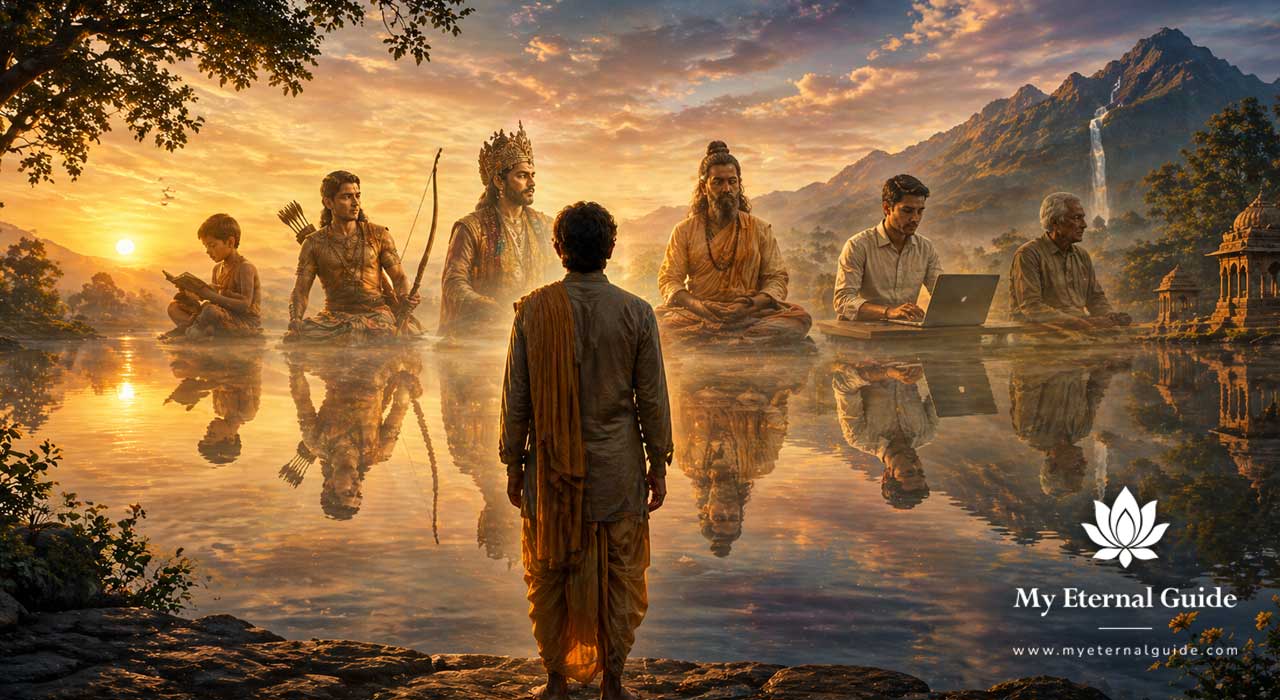
Rebirth is determined by our karma (actions), vasanas (deep impressions) and the state of our consciousness at the time of death. The Vedic texts explain that our accumulated tendencies guide the soul toward our next body, ensuring that our journey continues in alignment with our past actions and inner desires.
Scriptural Insight
A powerful verse from the Bhagavad Gita (Chapter 8, Verse 6) explains this idea clearly:
“Whatever state of being one remembers when he quits his body, that state he will attain without fail.”
This verse gives us a precise spiritual law. Our final thought is shaped by how we have lived, what we have practiced and what we have deeply identified with throughout our lives.
Rebirth Explained | The Story of King Puranjana from the Srimad Bhagavatam
King Puranjana’s story is narrated by the sage Narada Muni to King Pracinabarhi. It is deeply symbolic and offers a profound understanding of how our consciousness and attachments shape our next birth.
King Puranjana was a seeker looking for a suitable place to live. After wandering far and wide, he discovered a magnificent city with nine gates. This city was filled with beauty, pleasure, and opportunities for enjoyment.
Within this city, he met a charming queen. He became deeply attached to her and together they enjoyed a life filled with sensory pleasures, familial ties and worldly pursuits.
Over time, Puranjana lost the awareness of his true self. His identity became completely tied to the body, the senses and his relationships. His happiness depended on external experiences.
Years passed and eventually, old age and death approached. At the time of his death, his mind was filled with thoughts of his wife and the life he had lived with her. Because of this deep attachment, Puranjana was reborn as a woman in his next life.
The Deeper Meaning
This story is allegorical:
- The city with nine gates represents the human body
- The queen represents the mind
- The king’s attachment represents identification with worldly life
- The loss of awareness represents ignorance of our true self
The key teaching here is that whatever we identify with most strongly shapes our soul’s future. Puranjana’s rebirth as a woman was a direct reflection of his inner world at the time of his death.
What This Story Teaches Us About Rebirth
1. Identity Shapes Destiny
When we strongly identify with roles, relationships or possessions, they influence our consciousness deeply.
2. Attachment Directs the Mind
At the time of death, the mind naturally flows toward what it is most attached to.
3. Awareness Changes the Outcome
If Puranjana had remained aware of his true self beyond the body and mind, his journey would have taken a different direction.
We too, are building our inner world every day. Let’s ask ourselves: Are we identifying only with our roles and experiences or are we also nurturing awareness of something deeper within us?
What Truly Determines Rebirth?
1. Karma: The Law of Cause and Effect
Our actions, whether physical, verbal or mental, create karma. Karma is not a system of reward or punishment. It is a system of balance and learning. When we act with awareness, compassion and dharma, we create conditions for higher growth. When we act with selfishness or ignorance, we create lessons that we must learn. A helpful explanation of karma can also be explored through this Stanford resource:
https://plato.stanford.edu/entries/afterlife/
2. Vasanas: Deep Inner Impressions
Our repeated thoughts and actions form vasanas. These are subtle tendencies that live within our subconscious.
For example, if we constantly cultivate anger, fear or attachment, those impressions become strong imprints within us. If we cultivate peace, discipline and devotion, those tendencies become our natural state.
At the time of death, these vasanas influence our final thought. And that final thought determines our next direction.
3. State of Mind at Death
The Vedic texts consistently emphasize the importance of our final state of consciousness. This does not mean we focus solely only on our last moment. Our final thought is simply a reflection of how we have lived. If we have trained our mind to be in constant awareness of our inner selves, to surrender to our higher selves and to seek clarity, the mind naturally turns toward our higher consciousness in that final moment.
4. Our Attachments and Desires
Desire is a powerful force. It binds the soul to the cycle of birth and death. The Brihadaranyaka Upanishad explains:
“As is our desire, so is our will. As is our will, so is our action. As is our action, so is our destiny.”
Our desires create a direct chain from desire to destiny.
Practical Steps to Shape Our Future Birth
The beauty of Vedic wisdom is that it empowers us to consciously influence our onward journey. Follow the guidance below.
1. Practice Awareness Daily
Our thoughts shape our reality. By becoming aware of our thought patterns, we begin to transform them.
2. Align with Dharma
Living in alignment with dharma brings harmony inside and outside. It ensures that our actions help us grow rather than pull us down.
3. Cultivate Detachment
Detachment in this context means engaging fully in action without being concerned about outcomes.
4. Develop a Spiritual Practice
Meditation, mantra chanting and self-reflection train our mind. Over time, being calm and clear becomes our natural state.
For a deeper understanding of meditation practices, this guide from Harvard Health is useful:
https://www.health.harvard.edu/blog/want-a-calmer-brain-try-this-202410293078
5. Watch Our Attachments
Even noble emotions can turn into binding attachments if we lose awareness of our true naturel.
So think about this: If your final thought reflects how you have lived, what are you training your mind to return to every single day?
Remember that rebirth is a continuation of our soul’s journey. It reflects our growth, our choices and our awareness. The Vedic texts remind us that we are never stuck. Every moment offers us a chance to move in a new direction. When we live consciously, we begin shaping a future that aligns with clarity, peace and ultimately, liberation.
If the question of rebirth has been on your mind, it is already a sign of deeper seeking. Every answer opens the door to a more meaningful life.
At chat.myeternalguide.com, we explore these timeless questions with clarity and depth. You can ask your own question anytime and receive guidance rooted in the Vedic wisdom that has guided humanity for thousands of years.
Your journey deserves the right direction.
More Links for Deeper Exploration
To continue this journey, explore these related insights on MyEternalGuide:
- How do I deal with confusion in my life and my mind?
- Krishna and the mind | The Gita’s insights on human psychology
- What is dharma in Vedic texts?
Frequently Asked Questions (FAQs)
2. Can we change our next birth?
Yes. By changing our actions, thoughts and spiritual practices, we influence our future birth.
3. Why is the last thought important at death?
The last thought reflects our deepest conditioning and directs the soul toward its next experience.
4. Do spiritual efforts carry forward into the next life?
Yes. No sincere effort is ever lost. It continues from where we left off.
5. Is rebirth a punishment or a process?
Rebirth is a process of evolution and learning, guided by universal laws rather than judgment.
Our Karma combined with our mental impressions and final state of consciousness determines our next birth.
Yes. By changing our actions, thoughts and spiritual practices, we influence our future birth.
The last thought reflects our deepest conditioning and directs the soul toward its next experience.
Yes. No sincere effort is ever lost. It continues from where we left off.
Rebirth is a process of evolution and learning, guided by universal laws rather than judgment.
