
What Is Rebirth?
May 21, 2026 | By Madhura Samarth and Layla Nathwani
Short Answer
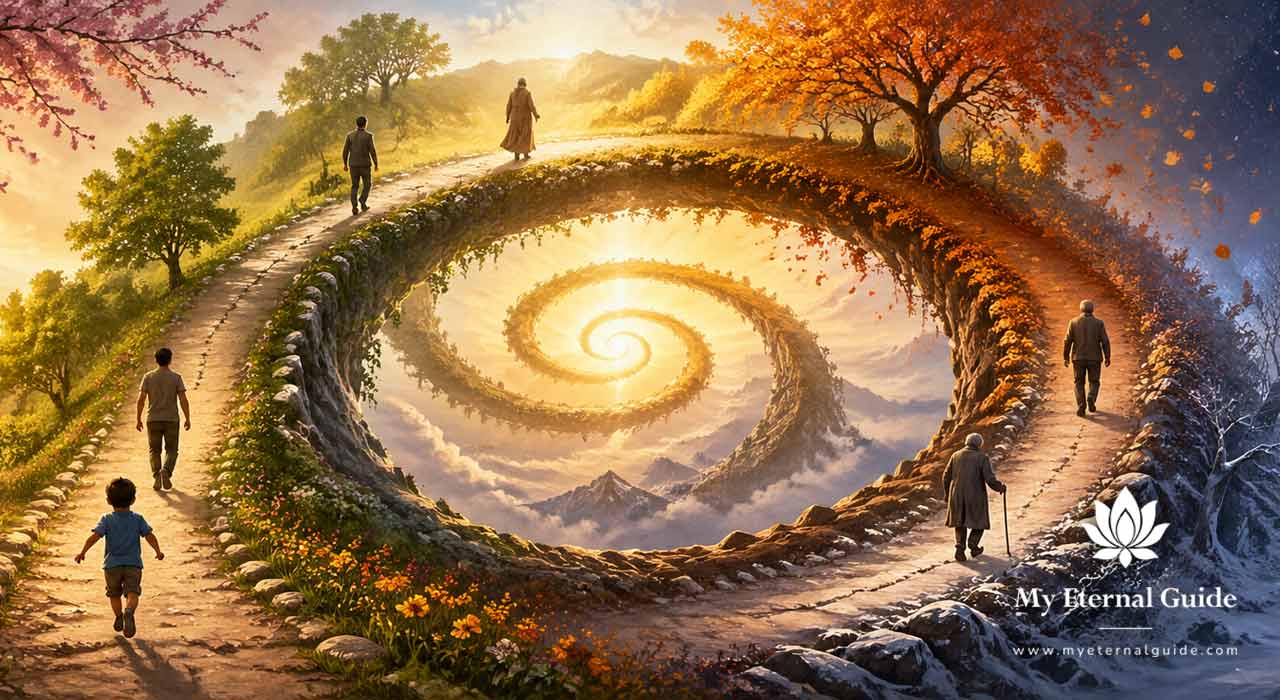
Rebirth, also known as reincarnation, is the Vedic understanding that our soul continues its journey after the physical body perishes. Guided by karma and desires, the soul takes on a new body to continue its evolution. This cycle continues until we attain self-realization and reconnect with our true spiritual nature.
Scriptural Verse
The Bhagavad Gita (2.22) says:
“Just as a person discards worn-out clothes and puts on new ones, the soul discards worn-out bodies and enters new ones”
The idea of rebirth often feels mysterious but the Vedic tradition presents it with immense clarity and logic. When we study the idea of rebirth closely, we find answers to many questions that otherwise remain unresolved. Why are individuals born into different circumstances ? Why do talents and fears appear without obvious causes? The Vedas offer a framework where these patterns stop seeming random.
Rebirth is rooted in two fundamental principles: the immortality of the soul and the law of karma. Our body changes from childhood to youth to old age…but something within us remains constant. That constant presence is the soul, or Atman. When the body can no longer sustain life, the soul continues its journey.
Karma acts as the guiding force. Every action, thought and intention leaves an imprint. These impressions shape the circumstances of our next life. In this way, rebirth is not a random process but a deeply structured continuation of our spiritual evolution.
For a deeper philosophical exploration, this resource provides a helpful overview:
🔗 https://www.britannica.com/topic/reincarnation)
A Story from the Scriptures: The Transformation of Ajamila
This story comes from the Srimad Bhagavatam and offers a deeply human perspective on rebirth, karma and the power of consciousness at the time of death.
Ajamila was born into a virtuous Brahmin family. In his early years, he lived a disciplined life rooted in dharma. He studied scriptures, served his parents and followed righteous conduct. His life reflected everything the Vedic path encourages.
One day, while walking through the forest, he saw a man and a woman behaving in a way that stirred desire within him. That single moment became a turning point. Instead of letting the thought pass, he allowed it to grow and take root. Over time, he abandoned his values and began living a life driven by attachment and indulgence.
He left his family and lived with a woman of questionable character. To sustain this lifestyle, he engaged in dishonest and harmful actions. The same person who once lived with discipline now found himself deeply entangled in karma.
Years passed. Ajamila grew old. Toward the end of his life, he had a young son named Narayana, whom he loved dearly. His attachment to this child was intense.
At the moment of death, as fear gripped him, he called out his son’s name, “Narayana.” In the Vedic context, Narayana is also a name of the Supreme Lord, Krishna.
Because his final thought and utterance were aligned with the divine name, something extraordinary happened. Messengers of death arrived to take his soul, as per his accumulated karma. At the same time, divine beings appeared, stopping them.
A debate followed. The divine beings explained that even though Ajamila had lived a life filled with negative karma, the remembrance of the divine at the final moment created a powerful shift. It purified his consciousness enough to give him another opportunity.
Ajamila did not attain liberation immediately. Instead, he was granted a chance to consciously transform. He regained awareness, withdrew from worldly distractions and dedicated the rest of his life to spiritual practice. In his next phase of existence, he progressed toward liberation.
What This Story Reveals About Rebirth
This narrative gives us several important insights:
1. Rebirth Reflects Our Inner State
Our actions matter, but our consciousness matters more. The state of mind we cultivate throughout life influences our transition at death.
2. No Effort is Ever Lost
Even after a lifetime of mistakes, a moment of genuine connection with the divine can redirect our journey.
3. Rebirth is Opportunity
The soul gets repeated chances to learn, refine and evolve.
4. Attention Plays a Role in our Destiny
What we focus on consistently becomes our nature. And that nature influences where we go next.
When we look at our own lives, we may see moments where we drift away from what we know is right. The story of Ajamila reminds us that while actions carry consequences, transformation is always possible.
Rebirth ensures that growth continues. It assures us that even if we falter, we are still on a journey that allows for correction, awareness and eventual realization.
Why Rebirth Makes Logical Sense
When we step back, rebirth offers answers that align with both observation and reason.
First, it explains inequality without assigning blame to a higher power. Each soul maintains its own karmic blueprint. Life circumstances are not punishments or rewards from outside but natural consequences of past actions.
Second, it provides continuity. Our growth does not end abruptly at death. Instead, life becomes a continuous journey of learning and refinement.
Third, it gives purpose to suffering. Challenges become opportunities to resolve past karma and evolve spiritually. This perspective transforms how we respond to difficulties.
Modern thinkers and scholars have also explored the concept of rebirth. Research into past-life memories, especially among children, continues to raise intriguing questions. You can explore rebirth from a Vedic view further here:
🔗https://vedabase.io/en/library/bg/2/22/
Practical Steps to Align with the Understanding of Rebirth
Understanding rebirth is useful but transformation happens when we apply this wisdom in our daily lives
1. Observe Our Actions with Awareness
Every action creates an imprint. When we act with awareness, we shape a more positive karmic future.
2. Refine Our Intentions
It is not only what we do but why we do it. Intentions rooted in compassion and clarity create lighter karmic impressions.
3. Practice Detachment
Attachment binds the soul to repeated cycles. Detachment does not mean indifference. It means engaging fully in one’s duty or action while remaining internally calm.
4. Cultivate Spiritual Knowledge
Regular study of scriptures deepens our understanding. Even a few minutes daily can help change our perspective.
5. Meditate on the Nature of the Self
Meditation helps us experience the difference between the body and the soul. This awareness reduces fear of death and strengthens our inner stability.
A question to think about – If our current life is part of a longer journey, how might our choices change when we see them as shaping our future in this life as well as many others?
The idea of rebirth invites us to expand our understanding of life beyond a single timeline. It brings responsibility, purpose and hope. Every moment becomes meaningful because it contributes to a much larger journey.
When we live with this awareness, our choices become more conscious. Our relationships become more compassionate and our challenges become stepping stones rather than obstacles.
If this perspective has sparked a question within you, you do not have to search alone. At chat.myeternalguide.com, you can explore answers rooted in timeless Vedic wisdom. You can also ask your own question, anytime and receive instant guidance that aligns with our journey.
Read the Blogs Below for More Vedic Teachings
- How do karma and consciousness affect what comes next?
- Krishna and the Mind | The Gita’s Insights on Human Psychology
- What is the soul?
Frequently Asked Questions (FAQs)
2. How does karma affect rebirth?
Karma determines the conditions of the next life based on past actions, thoughts and intentions.
3. Can we stop the cycle of rebirth?
Yes, through self-realization and spiritual knowledge, the soul can attain liberation and end the cycle.
4. What happens at the time of death according to Vedas?
The state of mind at the moment of death and accumulated karma influence the soul’s next birth.
5. Is rebirth scientifically proven?
While not fully proven, many studies and documented cases suggest evidence supporting reincarnation.
Rebirth is the process through which the soul takes a new body after death, guided by karma and desires.
Karma determines the conditions of the next life based on past actions, thoughts and intentions.
Yes, through self-realization and spiritual knowledge, the soul can attain liberation and end the cycle.
The state of mind at the moment of death and accumulated karma influence the soul’s next birth.
While not fully proven, many studies and documented cases suggest evidence supporting reincarnation.
