
Why Reflecting on Death Can Bring Peace
June 29, 2026 | By Madhura Samarth and Layla Nathwani
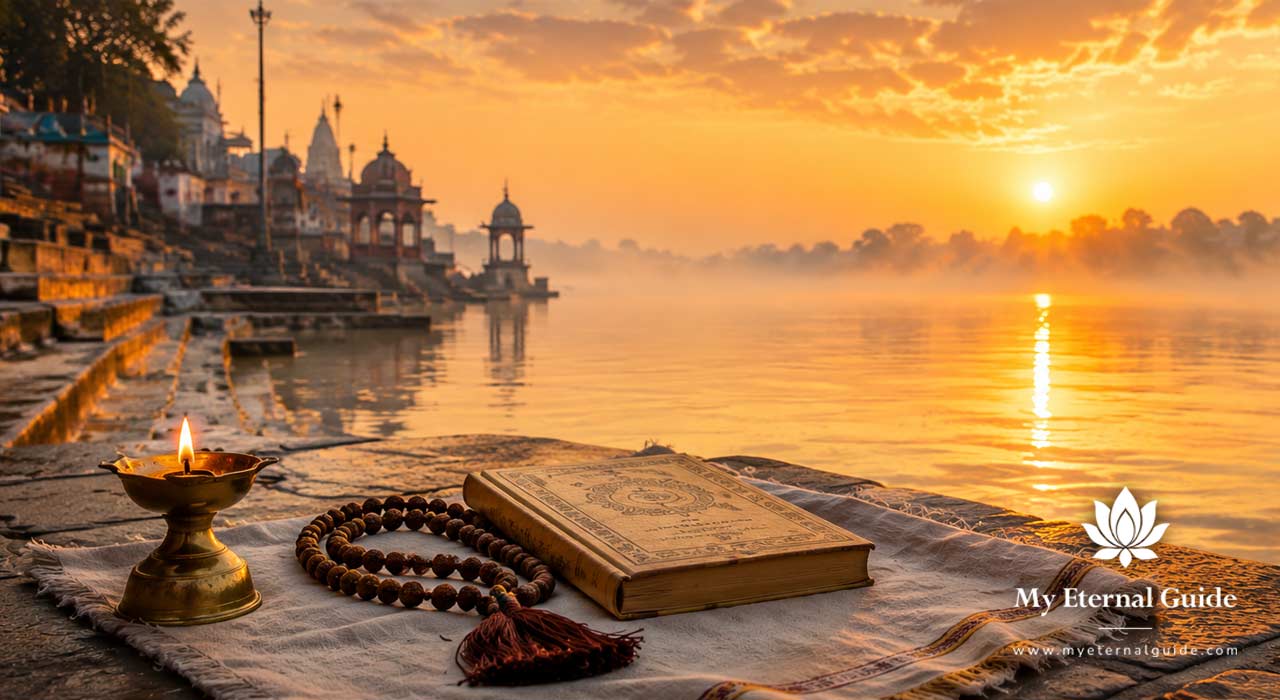
TL;DR: Reflecting on death can bring peace because it helps us see life with greater clarity. In the Vedic view, death is not simply an ending that we need to fear, but a reminder to live our lives with dharma, gratitude, detachment and devotion. When we recognize that our time on earth is limited, we begin to use our time & energy more wisely, value our relationships more deeply and turn toward what is eternal within us.
For the full Vedic explanation, including the story of King Parikshit and practical ways this reflection reduces fear, read the full article.
Why Reflecting on Death Can Bring Peace
Most of us spend our lives trying not to think about death. We fill our time with work, family duties, ambitions, conversations, entertainment, plans, responsibilities and worries. But somewhere in the background, we know that life is temporary. Every person we love, every role we play, every possession we gather and every situation we struggle with is touched by time.
For many people, death feels like a dark subject that is best avoided. But the Vedic tradition treats death as one of life’s greatest teachers. In the Vedic view, reflecting on death is about seeing life clearly. When we remember that our time here is limited, we begin to understand where to use our energy and where to spend our time. Small insults lose their power. Endless comparisons bother us less. Anger fades faster. Ego loses its hold. Love, truth, forgiveness, service and inner growth begin to take up more of our attention.
This is why the great scriptures bring up the subject of death. The Bhagavad Gita teaches that the soul is eternal, and the Atman, the true Self, is beyond birth and death. The Upanishads explore the mystery of life with great courage. The Puranas give us stories of kings, sages, devotees and ordinary people who discovered peace when they understood the temporary nature of the material world. If you would like to understand this idea more deeply, you can also read our guide on what the soul is in the Vedas.
One powerful example is King Parikshit from the Śrīmad Bhāgavatam. When he learned that he had only seven days to live, he sought guidance from sages. He listened, reflected, surrendered and used the certainty of death to understand the purpose of life. His story reminds us that the idea of death can either frighten the mind or awaken the soul, depending on how we approach it.
Modern life gives us countless ways to stay distracted, but at some point we all ask: Who am I beyond my name, body, profession and relationships? What have I done with the time given to me? Am I living according to dharma? Have I loved well? Have I forgiven? Have I grown?
Reflecting on death brings peace because reflection brings us to the truth. It helps us realize that our time on earth is limited and it’s not wise to postpone what matters. It reminds us to live more consciously, speak more kindly, choose more wisely and seek what is eternal within us.
The Vedic View: Death Is Just a Transition
The Vedic view of death begins with a simple distinction. We have a body, which changes, ages and eventually falls away. Then we have our Atman, the true Self, which is eternal, untouched by age and beyond destruction. Much of our fear around death comes from forgetting this distinction. We begin to think, “I am this body. I am this name. I am this role. I am this story.”
But the Vedic scriptures teach us that the body is a temporary dwelling for the soul, just as clothes are temporary coverings for the body. In Bhagavad Gita 2.22, Śrī Krishna explains this concept beautifully to Arjuna when he says that just as a person gives up worn out garments and accepts new ones, the embodied soul gives up old bodies and accepts new ones. This analogy is also closely connected to the Vedic teaching of rebirth, where the soul continues its journey beyond one lifetime.
Death, in the Vedic view, is a change in condition. The body completes its role, but the journey of the soul continues according to its karma, samskara, which are our natural propensities, and divine law. This understanding helps because it reminds us that existence is more than what the eyes can see and the senses can fathom. What belongs to matter will change. What belongs to the eternal remains.
Vedic wisdom asks us to understand death correctly. If we think life is only about the body, then every sign of ageing, illness, loss or uncertainty becomes frightening. But when we understand that we are Atman, death begins to feel less scary. It remains a serious reality, but it no longer has to be seen as the final end.
Krishna chose to give this wisdom on a battlefield. That itself is meaningful. The teaching is meant for real life, for moments of crisis, confusion, sorrow and responsibility. Arjuna was overwhelmed because he saw his loved ones on the opposite side of him on the battlefield and did not want to slay them. Krishna did not tell him to become hard hearted but taught him to look at the situation more discerningly. The people before him were eternal beings moving through the great flow of time, karma and dharma. This deeper vision gave Arjuna the strength to act in accordance with his duties without being broken by confusion and grief.
For us too, this teaching can bring peace. When we reflect on death through the Vedic lens, we are reminded that relationships are precious, but they are not possessions. The body is valuable, but it is not the whole truth of who we are. Success, failure, praise, insult, wealth and status all belong to the changing world. They deserve attention, but they do not define us.
This does not mean we become indifferent. In fact, the opposite happens. We care more deeply, but with less fear. We love with gratitude rather than control. We serve with sincerity rather than expectation. We forgive more easily because we understand how short human life is. We become less interested in proving ourselves and more interested in purifying ourselves.
The Vedic view also helps us understand why reflection on death can bring inner discipline. If the body is temporary and the soul continues, then our choices matter. Our thoughts, actions, intentions and attachments shape the direction of our journey. Every moment becomes an opportunity to move closer to wisdom, compassion, devotion and freedom.
Birth, growth, decay and death belong to prakriti, the changing field of nature. The Atman, however, is beyond this cycle. The more we identify only with prakriti, the more restless we become. The more we awaken to Atman, the more peaceful we feel.
Reflecting on death, therefore, is a doorway to right understanding. It teaches us that we are passing travellers here on earth. We are caretakers of the material objects we possess rather than owners. We are souls learning through experience, relationship, duty and devotion.
When this truth dawns on us, death becomes a reminder to live well, to act with dharma, to seek the eternal and to remember that the deepest part of us was never born and can never die.
Why Remembering Death Makes Life More Meaningful
When we remember that we will die one day, life becomes sharper, clearer and more precious. The ordinary moments we usually don’t even notice begin to come into focus. A conversation with a parent, a meal with family, a quiet morning, a chance to apologise, a prayer before sleep, a small act of kindness, all these begin to feel important.
In daily life, we often behave as though our time here is unlimited. We postpone difficult conversations. We assume we will forgive later, heal later, pray later, change later and live more sincerely later. But thinking about death dispels this illusion. We think more carefully about how we are spending our time.
The Vedic tradition repeatedly reminds us that human birth is rare and valuable. It is not meant only for eating, earning, competing, worrying and seeking comfort. These have their place, but they are not the highest purpose of life. Human life gives us the ability to ask deeper questions, to choose dharma, to refine our character, to seek moksha and to realize our relationship with the Divine.
When we forget the value of time, we become trapped in smallness. A rude message can ruin our day. A comparison on social media can disturb our peace. Someone else’s success can make us feel jealous. A minor disagreement can become a long conflict. The ego keeps telling us that everything is urgent, everything is personal and everything must be in our control.
But remembering our mortality helps us ask, “Is this worth the limited time I have been given?” That one question can change the direction of the mind. It can stop an argument before it explodes. It can curb our pride before it damages our relationship. It can help us choose silence where anger would create harm. It can remind us that peace is often more valuable than being right.
This is one of the gifts of reflecting on death. It helps us separate what is truly important from what is merely noisy. Our lives today are full of noise. Notifications, opinions, deadlines, desires, anxieties and comparisons constantly compete for our attention. But at the end of life, we are unlikely to ask how many people praised us, how many things we owned or how many arguments we won. We are more likely to ask whether we loved well, lived truthfully, served sincerely and grew from within.
In the Bhagavad Gita, Krishna guides Arjuna toward action rooted in dharma rather than fear, attachment or confusion. This teaching is deeply relevant as we reflect on death. Remembering death does not mean withdrawing from responsibility. It means taking care of our responsibility with greater purity. A parent becomes more present. A leader becomes more ethical. A student becomes more disciplined. A seeker becomes more sincere. A householder begins to see family life itself as a field of dharma.
Awareness of death also brings gratitude. When we assume what we have will always be there, we stop seeing the beauty in all that we have and experience. We take people for granted. We take our health for granted. We take the breath itself for granted. But when we remember that everything in our life is temporary, gratitude comes naturally. We begin to value the body as an instrument for dharma. We value relationships as opportunities for love and growth. We value time as a gift.
Reflecting on death also makes spiritual practice more meaningful. Many people turn to prayer only when life becomes difficult. But remembering our mortality encourages a steadier relationship with the Divine. It reminds us that spiritual life is the foundation of a peaceful life. Japa, meditation, seva, study of scripture and satsang become ways to keep the mind aligned with what is eternal.
There is also great emotional freedom in this reflection. When we realize that every human being is facing uncertainty at every moment, our heart becomes softer. We judge less quickly. We forgive more easily. We understand that behind people’s anger, ambition and fear is often a soul trying to find safety and meaning. Death reminds us that everyone is vulnerable. This recognition can enhance our compassion.
A life lived with remembrance of death is a life of clarity. It is the understanding that every sunrise is an opportunity, every relationship is a responsibility, every choice leaves an imprint and every breath can become a step toward peace.
King Parikshit: The Man Who Used Seven Days to Find Peace
The story of King Parikshit in the Śrīmad Bhāgavatam is one of the most powerful reminders that death can become a teacher when we are humble enough to accept that we have a lot to learn.
Parikshit was a noble king, the grandson of Arjuna and a ruler who had inherited the spiritual and royal legacy of the Pandavas. He had power, status, responsibility, family, and a kingdom to protect. In many ways, he had everything that people in the world usually strive for. But even his position could not protect him from the uncertainty of the material world.
One day, while hunting in the forest, King Parikshit felt exhausted, thirsty and hungry. In that disturbed state, he entered the āśrama of Sage Śamika. The sage was deep in meditation and did not respond to the king. Feeling ignored and overcome by a moment of weakness, Parikshit placed a dead snake around the sage’s neck to insult him.
This action went against his true nature. And this is part of what makes the story so meaningful. The scriptures do not present great people as flawless figures who never make mistakes. They show us that even noble people can stumble when hunger, fatigue, ego and anger cloud the mind. But they also show us that one mistake does not define us. When we accept our mistake, repent and return to dharma, we can move forward with grace.
When the sage’s son, Śṛṅgi, heard what had happened, he became furious and cursed King Parikshit to die from a snake bite within seven days. Parikshit accepted the reality of death with humility. He recognised his mistake, gave up attachment to royal comfort and turned toward the highest question a human being can ask: What should one do when death is near?
The Śrīmad Bhāgavatam records this turning point beautifully. Parikshit went to the sacred riverbank and fixed his mind on spiritual realization, as described in Śrīmad Bhāgavatam 1.19.5 and Śrīmad Bhāgavatam 1.19.7.
In truth, this question is not only for Parikshit but for all of us.
He had seven days. We may have more or we may have less. The difference is only that Parikshit knew the number. His situation makes visible the hidden condition of every human life. Time is limited, the body is temporary and the future is uncertain. The wise response is to live with awareness.
Parikshit went to the banks of the Ganga, surrounded by sages and seekers. There, Śukadeva Goswami arrived and began to speak the wisdom of the Śrīmad Bhāgavatam. For seven days, Parikshit listened with full attention. He asked about the highest duty of a person who is about to die, and through that question, he gave humanity a timeless teaching. His question in Śrīmad Bhāgavatam 1.19.38 asks what a person should hear, chant, remember, worship and avoid.
When death came close, he was ready. Before the curse, Parikshit was a king managing the affairs of a kingdom. After the curse, he became a seeker preparing the soul for its onward journey.
His story teaches us that peace does not always come from changing circumstances. Sometimes peace comes from seeing circumstances through a higher understanding. Parikshit could not change the fact that death was approaching, but he could choose the consciousness with which he met it. That choice transformed his final days into a sacred offering.
For modern readers, this story is more relevant than ever before. We may not be sitting beside the Ganga with sages around us, but we too receive reminders of impermanence. A health scare, the death of someone we love, ageing parents, an unexpected loss or even a moment of loneliness can make us realise that life is fragile. These moments can either push us into fear or invite us into wisdom.
Parikshit teaches us that the awareness of death can help us ask better questions. Instead of asking only, “How can I get more?” we begin to ask, “How can I become wiser? How can I live with dharma? How can I leave this world with a peaceful heart?” Parikshit showed us that we can be peaceful even in the face of death.
How Reflecting on Death Reduces Fear
Fear of death is one of the deepest fears in the human mind. Sometimes it appears directly as anxiety about dying. At other times, it hides behind other fears: fear of ageing, fear of illness, fear of losing people we love, fear of failure, fear of becoming irrelevant, fear of being forgotten, or fear of the unknown. Modern psychology also recognises intense fear of death as death anxiety or thanatophobia, and the Cleveland Clinic explains that it can affect daily life when it becomes overwhelming.
The Vedic way asks us to understand fear. Fear grows when the mind believes that the body is the whole of the self. If I think I am only this body, then every change in the body feels like a threat to my existence. Ageing becomes frightening. Illness becomes unbearable. Death becomes the final terror. But if I begin to understand that the body is the vehicle and the Atman is the true Self, then fear starts to dissipate. The body changes, but the Self is deeper than the body.
This is why the Bhagavad Gita gives so much importance to right knowledge. Śrī Krishna does not allay Arjuna’s fear by promising that nothing painful will happen. He shows him what is eternal and what is temporary. Once Arjuna begins to see beyond the surface of life, he gains the courage to act with steadiness.
The take away for us? Peace does not come from pretending that death will never touch us. Peace comes from understanding that death touches the body, but the soul continues its journey. Another reason reflection on death reduces fear is that it brings familiarity. What we refuse to think about often becomes more frightening in our imagination. If fear of the unknown is something you struggle with, this related MyEternalGuide article on how to stop fearing the future may also help.
Death reflection also reduces fear by improving the way we live today. Many people fear death because, deep within, they feel they have not lived fully or rightly. There may be guilt, unfinished conversations, unresolved anger, neglected spiritual practice or a sense of having wasted time. When we remember that death will come one day, we are pushed to correct these things while we still can.
We apologize sooner. We forgive faster. We stop postponing prayer. We spend time with people who matter. We act with more honesty. We become more careful with our words. We begin to choose dharma over ego, because we understand that every action leaves an imprint on us.
The Vedic scriptures also remind us that remembrance of the Divine at the time of death is highly significant. But the final remembrance is shaped by the habits of a lifetime. Bhagavad Gita 8.6 teaches that the state of consciousness remembered at the time of leaving the body deeply matters. If the mind has spent years absorbed only in fear and distraction, it may struggle to turn inward in the final moment. But if we remember the Divine daily, through japa, prayer, gratitude, scripture and service, then remembrance at the moment of death becomes a real possibility. The moment of death becomes another moment in which the soul turns toward its eternal source.
This is why spiritual practice is not merely preparation for death. It is preparation for peaceful living. Every time we chant, reflect, serve or sit in silence, we train the mind to focus on the inner self rather than on circumstances. We learn to return to the Divine while life is still moving. Then, when uncertainty comes, the mind has a sacred direction.
Fear reduces when trust increases. Trust in dharma. Trust in karma. Trust in the wisdom of the scriptures. Trust in the presence of the Divine. Trust that the soul’s journey is held within a larger order than the mind can fully understand.
We may still grieve when a loved one dies. We may still miss those we love. We may still feel the pain of parting. But Vedic wisdom gives that tenderness a foundation. It tells us that love is not meaningless, life is not accidental and death is not the end of existence.
Fear then becomes reverence. Anxiety becomes inquiry. Attachment becomes gratitude. And death, which once seemed like an enemy, begins to appear as a stern but compassionate teacher guiding us toward the eternal.
Death as a Teacher of Detachment
Death teaches us the process of detachment in a way that few other experiences can. It reminds us that everything we hold dear, manage, protect, desire and identify with is temporary. This truth is difficult to digest at first, but in the Vedic view, it liberates us.
The Sanskrit word often used for detachment is vairagya. Many people misunderstand vairagya as emotional coldness, absence of love or withdrawal from life. But true vairagya is the presence of wisdom within love. When we practise vairagya, we care deeply without being attached. We act responsibly while accepting that life is not fully in our control. We enjoy the blessings given to us while remembering that they have been entrusted to us for a short span of time.
This is why reflecting on death can bring us so much peace. The tight grip of “mine” begins to lose its hold on us. My status. My wealth. My opinion. My victory. My image. My way. The mind suffers because it tries to possess what was never fully possessable. Relationships, health, youth, success, praise and comfort are all subject to change. When we expect permanence from temporary objects, we create anxiety within ourselves. When we understand the nature of life, gratitude begins to take the place of fear. For a deeper discussion of this theme, read how Vedic wisdom helps us overcome greed and attachment.
The Bhagavad Gita repeatedly guides us toward this balanced way of living. Śrī Krishna asks Arjuna not to abandon action. He guides him to act without unhealthy attachment to the fruits of action. This teaching is stated clearly in Bhagavad Gita 2.47, where Krishna explains that we have a right to action, but not ownership over the fruits of action. This is one of the clearest forms of detachment. We do what is right because it is right, not because we can control the results. We fulfil our dharma, put in our effort and accept that outcomes unfold within a larger order of karma, time and divine intelligence.
Thinking about death makes this teaching easier to understand. We still work sincerely. We still love our families. We still build, create, earn, serve and participate in the world. But we begin to do these things with less anxiety. We stop making every success a proof of our worth and every failure a wound to our identity.
This kind of detachment is especially needed in modern life. Today, many people are attached not only to their possessions but to their image as well. How we are seen, liked, judged, followed, praised or compared has become a major source of anxiety. But when we reflect on death we ask, “Will this matter when the body is gone?” We begin to see that every failure is not the end of the world.
Detachment also changes the way we love. When we are attached we say, “You must be as I want you to be for me to feel secure.” Love with vairagya says, “I will care for you, support you, guide you where I can and honour the journey your soul must take.” This is a higher and more peaceful love. It gives space. It reduces our need for control. It understands that each soul comes with their own karma. It recognises that every person, even those closest to us, belongs first to the Divine.
This does not mean we become passive when action is needed. Vedic detachment is active, responsible and courageous. A detached person can protect dharma, speak truth, fulfil duties, care for the body and serve society. The difference is that there is no inner turmoil while acting or when the fruits of action arrive.
Death also teaches us to let go of old conflicts. Many arguments go on only because our ego keeps feeding them. When we reflect honestly on mortality, we begin to see how costly resentment is. A grudge can occupy our heart for years, but when we see how short life really is, we stop carrying it. Forgiveness becomes a better option than holding on to bitterness. Keeping quiet becomes wiser than proving a point. Reconciliation becomes more valuable than holding onto pride.
In this way, death becomes a stern but compassionate guru. It shows us what cannot accompany us beyond this life. We cannot carry our bank balance, our awards, our grudges, our social image or our physical beauty. But the impressions of our actions, the purity of our intentions, the love we gave, the dharma we upheld and the devotion we cultivated continue to shape the soul’s journey.
To reflect on death is therefore to learn what to hold and what to release. Hold dharma. Hold truth. Hold compassion. Hold remembrance of the Divine. Release arrogance, comparison, greed, needless resentment and the illusion that we can ever be in control.
When vairagya awakens, life becomes simpler. We enjoy what comes to us with gratitude. We accept what is taken away from us with maturity. We act where action is needed. We surrender where surrender is wiser. And slowly, we find the kind of peace that does not depend on our circumstances.
How This Reflection Helps in Modern Life and Teaches Us to Live Fully
Modern life has made us very skilled at staying busy but not always skilled at being peaceful. We know how to respond to messages, attend meetings, manage payments, plan holidays, meet deadlines and keep up with the world. But many people feel anxiety, loneliness, comparison, grief, burnout and a sense that life is passing too quickly.
Reflecting on death brings the mind back to what is real. It cuts through the illusion that everything is equally important. In a world where every notification appears to be urgent, our mortality reminds us that urgency and importance are not the same. A delayed reply, a missed social event, a colleague’s opinion, or a temporary setback may disturb the mind today, but death asks us to see them in proportion. Will this matter to the soul? Will this matter when life is reviewed with honesty? Will this bring me closer to peace, dharma and the Divine?
For someone experiencing burnout, death reflection can reveal that constant exhaustion is not a badge of honour. The body is temporary, but it is also sacred. It is the instrument through which we serve, love, pray, work, learn and fulfil dharma. When we misuse the body in the name of ambition, we forget its sacred role. Reflecting on death helps us ask whether our success is costing us our inner life. It reminds us that achievement without peace is incomplete.
For those caught in comparison, death reflection offers freedom. Modern society often teaches people to measure life through income, beauty, influence, possessions, followers, status and speed. But the Vedic lens asks a different question: What is the state of your consciousness? Are you becoming more truthful, compassionate, disciplined, generous and devoted? These are the qualities that refine the soul. They matter more than the image we maintain before the world.
In relationships, remembering death can soften the heart. Many families suffer because people postpone showing their love but are quick to express anger. We assume there will always be another day to apologise, another phone call, another chance to say what should have been said. But life is uncertain. Reflecting on death can help us speak with more care, forgive with more willingness and stop turning small disagreements into lifelong distances.
This reflection is also powerful during grief. Vedic wisdom does not ask us to deny the pain of separation. Grief is natural because love is real. But the teachings of the Atman give grief a sacred context. The body may fall, but the soul’s journey continues. This understanding does not prevent our tears from falling, but it can bring dignity, prayer and trust into sorrow. It allows us to remember loved ones with gratitude rather than only with pain. Readers who are grieving may also find comfort in this related article: Will I Meet My Loved Ones Again? Vedic Wisdom on Life After Death.
For young people, death reflection can bring direction. When life seems full of endless possibilities, it is easy to drift. The awareness of mortality asks us to choose consciously. What kind of person am I becoming? What habits are shaping my mind? What desires are ruling my choices? What will I be proud of when I look back? These questions help youth use their energy for growth rather than distraction.
For older people, death reflection can bring acceptance and spiritual urgency. Ageing often brings physical change, loss and the awareness that many chapters of life have already passed. Vedic wisdom offers a peaceful way to meet this stage. It encourages remembrance of God or Bhagavān, the Supreme Controller, simplification of desires, forgiveness, charity, scripture and preparation of consciousness. The later years of life can become deeply luminous when they are used for inner ripening.
At every age, reflecting on death teaches us the same essential truth: Peace is not something to search for only after every problem is solved. Peace begins when we align ourselves with what is eternal while still living fully in the temporary world.
This is why the Vedic way does not treat death as a dark interruption to life. It treats death as a mirror that reflects the quality of the way we have lived. When we look into that mirror with courage, we see what needs to change. We see where we are attached, where we are afraid, where we are wasting time and where we are being called toward dharma.
To live fully does not mean chasing every desire. It means living with awareness. It means doing your duty with sincerity, loving without possession, speaking truth with kindness, caring for the body as a sacred instrument, serving where you can and remembering the Divine through the changing seasons of life.
A person who reflects on death in this way does not become less alive. They become more alive. They stop waiting for the perfect moment to become peaceful. They begin now. They stop treating relationships casually. They become present. They stop letting ego spend their limited time. They choose humility. They stop assuming that spiritual life can be delayed indefinitely. They turn inward today.
Death reminds us that every breath is borrowed, but it also reminds us that every breath can be blessed. Every day can become an offering. Every action can become part of our dharma. Every difficulty can become a teacher. Every relationship can become a field of love and growth.
In the end, reflecting on death brings peace because it teaches us how to live before we die. It brings clarity where there was confusion, gratitude where there was entitlement, surrender where there was need for control and devotion where there was fear. It helps us remember that while the body belongs to time, the deepest truth within us belongs to the eternal.
If this article brought up a question in your heart, you can ask it for free at chat.myeternalguide.com. MyEternalGuide was created to help seekers find guidance from Vedic wisdom at the moment they need it most. You can also explore more reflections on the MyEternalGuide blog.
May your reflection lead you to clarity, peace and a life lived closer to dharma.
Frequently Asked Questions (FAQs)
2. What is the Vedic view of death?
The Vedic view of death is that the body is temporary, but the Atman, the true Self, is eternal. Death is seen as a transition in the soul’s journey. Its journey is shaped by its karma, samskara and divine law. This understanding helps reduce fear of death and gives our life deeper meaning.
3. Does the Bhagavad Gita say the soul dies?
No. The Bhagavad Gita teaches that the soul is eternal and does not die when the body dies. Śrī Krishna explains that the embodied soul changes bodies just as a person changes worn out clothes. This teaching is central to the Vedic understanding of death and peace.
4. How can reflecting on death reduce fear?
Reflecting on death reduces fear by helping us understand the temporary nature of every aspect of our life on earth. Fear grows when we identify strongly with material things - the body, possessions, roles and relationships. Vedic wisdom teaches that we are actually the soul which is eternal. The body may perish but the soul lives on. This deeper understanding gives us strength, clarity and trust.
5. Who was King Parikshit and why is his story important?
King Parikshit was a ruler in the Śrīmad Bhāgavatam. He was cursed to die in seven days. Instead of reacting with panic, revenge or denial, he turned toward spiritual wisdom. His story shows how the awareness of what lies beyond death can lead to surrender, clarity and peace in this life.
6. What does death teach us about detachment?
Death teaches us that everything in the material world is temporary. This understanding helps us practise vairagya, which means healthy detachment. Vairagya does not mean becoming cold or distant. It means loving deeply while remembering that nothing in this world is fully ours to control.
7. Is reflecting on death negative or depressing?
In the Vedic tradition, reflecting on death is not meant to make us sad. It is meant to awaken us to the truth of life - that the body may perish but the soul is eternal. When approached with wisdom, death reflection helps us live more fully, forgive more easily, use time wisely and enhance our relationship with the Divine.
8. How does death reflection help in modern life?
Death reflection helps in modern life by reducing unnecessary anxiety comparison and over attachment to success. It reminds us that urgency and importance are not the same. This differentiation can help us make better choices in relationships, work, health, spiritual practice and daily living.
9. What is vairagya in simple words?
Vairagya means detachment or to love without attachment. It is the ability to care, love, work and serve without the need to control or possess. In Vedic thought, reflecting on death helps awaken vairagya because it shows us what is temporary and what is eternal.
10. How should I reflect on death peacefully?
You can reflect on death peacefully by reading the Bhagavad Gita, practising japa, doing seva, reviewing your actions, forgiving where possible, spending time in prayer and remembering that the body is temporary but the soul is eternal.
11. Can remembering death make relationships better?
Yes. Remembering death can make relationships more loving and honest. It reminds us not to postpone apologies, affection or forgiveness. When we realise that life is uncertain, we become more careful with our words and more present with the people we love.
12. What is the main lesson of reflecting on death?
The main lesson is that life should be lived with awareness. Death reminds us to choose dharma over ego, gratitude over entitlement, forgiveness over resentment and devotion over distraction. It teaches us how to live before we die.
Thinking about death can bring peace because it helps us remember what truly matters. When we recognize that life is temporary, we become less disturbed by ego, comparison, anger and small conflicts. The Vedic tradition teaches us that reflection on death can make us more conscious, grateful and spiritually focused.
The Vedic view of death is that the body is temporary, but the Atman, the true Self, is eternal. Death is seen as a transition in the soul’s journey. Its journey is shaped by its karma, samskara and divine law. This understanding helps reduce fear of death and gives our life deeper meaning.
No. The Bhagavad Gita teaches that the soul is eternal and does not die when the body dies. Śrī Krishna explains that the embodied soul changes bodies just as a person changes worn out clothes. This teaching is central to the Vedic understanding of death and peace.
Reflecting on death reduces fear by helping us understand the temporary nature of every aspect of our life on earth. Fear grows when we identify strongly with material things – the body, possessions, roles and relationships. Vedic wisdom teaches that we are actually the soul which is eternal. The body may perish but the soul lives on. This deeper understanding gives us strength, clarity and trust.
King Parikshit was a ruler in the Śrīmad Bhāgavatam. He was cursed to die in seven days. Instead of reacting with panic, revenge or denial, he turned toward spiritual wisdom. His story shows how the awareness of what lies beyond death can lead to surrender, clarity and peace in this life.
Death teaches us that everything in the material world is temporary. This understanding helps us practise vairagya, which means healthy detachment. Vairagya does not mean becoming cold or distant. It means loving deeply while remembering that nothing in this world is fully ours to control.
In the Vedic tradition, reflecting on death is not meant to make us sad. It is meant to awaken us to the truth of life – that the body may perish but the soul is eternal. When approached with wisdom, death reflection helps us live more fully, forgive more easily, use time wisely and enhance our relationship with the Divine.
Death reflection helps in modern life by reducing unnecessary anxiety comparison and over attachment to success. It reminds us that urgency and importance are not the same. This differentiation can help us make better choices in relationships, work, health, spiritual practice and daily living.
Vairagya means detachment or to love without attachment. It is the ability to care, love, work and serve without the need to control or possess. In Vedic thought, reflecting on death helps awaken vairagya because it shows us what is temporary and what is eternal.
You can reflect on death peacefully by reading the Bhagavad Gita, practising japa, doing seva, reviewing your actions, forgiving where possible, spending time in prayer and remembering that the body is temporary but the soul is eternal.
Yes. Remembering death can make relationships more loving and honest. It reminds us not to postpone apologies, affection or forgiveness. When we realise that life is uncertain, we become more careful with our words and more present with the people we love.
The main lesson is that life should be lived with awareness. Death reminds us to choose dharma over ego, gratitude over entitlement, forgiveness over resentment and devotion over distraction. It teaches us how to live before we die.
